

Cities have long been seen as the antithesis – or, at least, the absence – of nature. Yet in recent years, environmentalists started rethinking their long-held prejudices against urban areas. The rise of neighborhood-based environmental justice movements, beginning in the 1980’s, forced us to confront the human side of pollution and its relationship to urban poverty. The evolution of green building standards and advances in sustainable design helped us imagine an environmentally enlightened future for our offices and homes. The growing number of city-dwellers across the planet may have played the biggest role in our shifting perceptions of cities and nature. Moving “back to the land” and “living off the grid” could never be a tenable option for three and a half billion people. The result would end up closer to an explosion in suburban sprawl than a no-impact return to simpler times. Like it or not, we’ve realized that cities will have to figure into our schemes for a sustainable planet.
Despite this growing acceptance of cities within environmental circles, we haven’t completely let go of all our negative associations and assumptions. Old habits die hard. Images of polar bears and pine forests still grace the homepages of large environmental organizations. Intellectually, we’ve grown more comfortable seeing the nature in cities and, at the same time, understanding cities as unique manifestations of nature in and of themselves. Yet emotionally, it still doesn’t click. In New York City, Central Park seems categorically different from Grand Central Terminal.
How might we start to intuitively feel what our minds have started to know? Matthew Gandy, the prolific British geographer, makes a compelling case for seeing cities as cyborgs – “beings with both biological and artificial parts” according to Wikipedia’s definition of this concept from the space age. Looking back, you might say that cities have always been cyborgs, even if we didn’t see them that way. Even the earliest cities – both old world and new – were defined by the blended infrastructures and ecosystems that made their perpetuation possible. The Aztecs built Tenochitilan atop Lake Texcoco and created canals and aqueducts to manipulate the region’s hydrology. You’ll still find Mexico City there today.
Gandy suggests that the cyborg metaphor helps “fire the imagination” as we struggle to describe the complex interplay between urban infrastructure and ecology. The recent TNOC post, “Cities of Nature” by Eric Sanderson of the Wildlife Conservation Society, explores the difficulties we face in getting across what we mean, exactly, when we start talking about the “nature of cities.” Are we talking about parks and green spaces? Or are we talking about the whole city as an ecosystem all its own? Seeing cities as cyborgs may help us find ways to get on the same page.
The cyborg metaphor may also help us avoid spinning that same old “cities versus nature” yarn. Cities undeniably transform landscapes – both near and far away. But any permanent human settlement is bound to change things. A zero impact city – a city without the artificial stuff – is a city that never comes into existence. To that end, if we still value cities for all of the many reasons humans have valued cities for millennia, we need to stop trying to make them more “like nature.” As James Howard Kunstler reminds us, there’s little good that comes from trying to solve urban problems with “nature Band-Aids.” The cyborg city doesn’t need to be made “more natural.” Nor, for that matter, does it need to be made “more artificial” (the tacit goal of the Modernist City with its own legacy of failure). Instead, the cyborg needs to be made more resilient. It needs to work better.
We can spend a lifetime debating what, exactly, it means for a city to work better in light of all our different goals for ongoing human existence on this planet. Yet for many grassroots environmentalists, there’s no time to waste. They’re happy to shoot from the hip and just get started, growing gardens and tending street trees and sowing oyster reefs to clean polluted waters. Others are going one step further. They’re working to program the cyborg city to make it smarter – to make it talk back at us and tell us how our efforts are progressing. One of these cyborg ventriloquists is Leif Percifield, a recent graduate of the M.F.A. program in Design and Technology at Parsons The New School For Design in New York City. A self avowed “creative technologist,” Percifield’s DontFlush.Me project aims to help us interact more intelligently with one of the cyborg city’s metabolic systems – its sewers.
Percifield’s goal with DontFlush.Me is straightforward. “I want you to know exactly when your sewer pipe is connected to the river instead of a sewage treatment plant,” he says. Deploying a network of D.I.Y. sensors and rooftop weather stations across the city, he believes he can do just that.
Like most older industrial American cities, New York is built on top of a combined sewage system – “Basically just a storm sewer and a sanitary sewer meeting in the same pipe,” Percifield explains. “The pipe where you flush your toilet and the pipe that collects the stormwater from the street all go to the same place.” Throughout most of the city’s history, sewage from this combined system poured directly into the rivers, canals, and bays that make up New York harbor, polluting its waters and silting up its shipping channels with human waste.
Joseph Mitchell, the harbor’s unofficial ethnographer during his tenure at The New Yorker, described the state of local waterways by the 1940’s and ‘50’s:
“In most places, [the Harbor’s bottom] is covered with a blanket of sludge that is composed of silt, sewage, industrial wastes, and clotted oil. The sludge is thickest in the slips along the Hudson, in the flats on the Jersey side of the Upper Bay, and in backwaters such as Newtown Creek, Wallabout Bay, and the Gowanus Canal. In such areas, where it isn’t exposed to the full sweep of the tides, it accumulates rapidly.”
The city’s first sewage treatment plants, built in the 1890’s to improve water quality along popular beaches in Brooklyn, were quickly overwhelmed by New York’s booming population. More treatment plants were added throughout the early twentieth century, but the city’s desultory investments in infrastructure were no match for the volume of waste flowing from apartments, offices, and industry. By the time Mitchell started reporting on the harbor, the city’s waters had mostly been left for dead.
Large-scale efforts to treat raw sewage would only arrive with the federal Clean Water Act of 1972, mandating widespread improvements in municipal water quality. During the next three decades, the city would build new treatment plants and expand capacity at facilities that were, in some instances, already operating for nearly a century. Water quality gradually improved, but sewage still makes its way into New York Harbor in the 21st Century – approximately 27 billion gallons per year, according to Percifield.
“When it rains, the volume of water quickly causes the combined system to be overloaded,” he explains. “Currently, combined sewers are the number one source of pollution in New York harbor.”
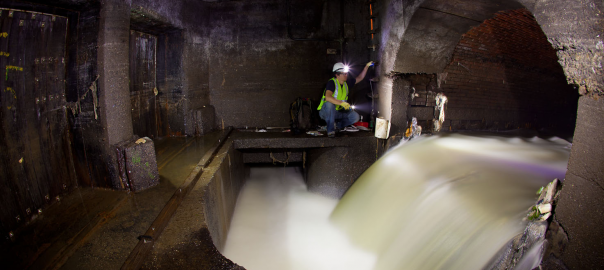
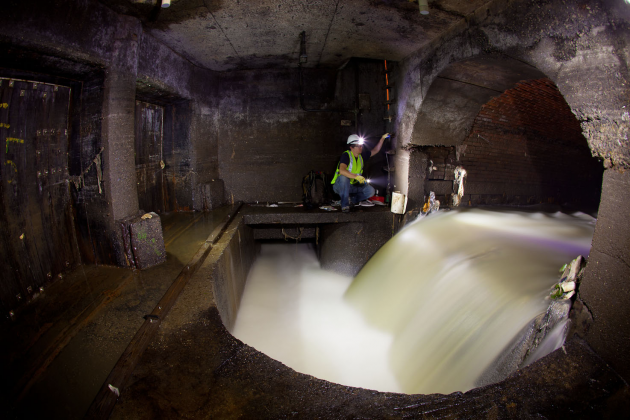
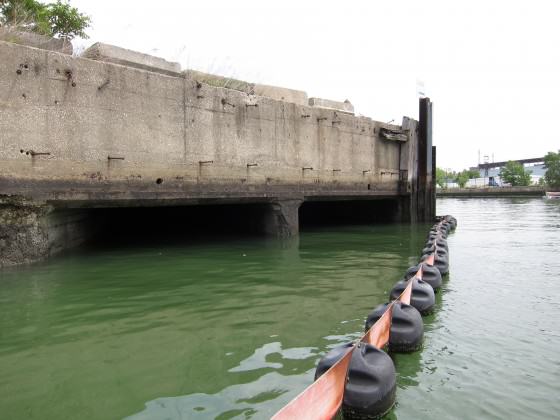
Through the city’s fourteen treatment plants are designed to handle 1.3 billion gallons of sewage each day, even a small rainstorm can overwhelm the system with excess water. The rising slurry of human waste and street runoff bypasses the treatment plants and flows to the nearest “combined sewage outfall” – an engineer’s euphemism for open pipes that dump into the harbor. Right now, nearly 500 combined sewage outfalls are scattered across New York City, each pouring untreated sewage from the Bronx River to Jamaica Bay and everywhere in between.
The reasoning behind DontFlush.Me is elegantly simple: if New Yorkers knew exactly when an overflow was underway, they’d think twice about loading the dishwasher, taking a long shower, or, even, flushing the toilet. Its the old “let it mellow” logic, with a twist. Once the overflow is over, city dwellers will get the “all clear” to flush once again. There’s just one catch. Right now, the only way to know whether an overflow is happening is to witness it, first hand, at the tail end of a pipe.
“The most important thing is understanding when these overflows occur,” according to Percifield. Yet it’s unlikely that most New Yorkers will be standing around an overflow pipe in the middle of a downpour waiting to find out whether it is safe to flush the toilet back home. The cyborg city needs a better way of sensing itself.
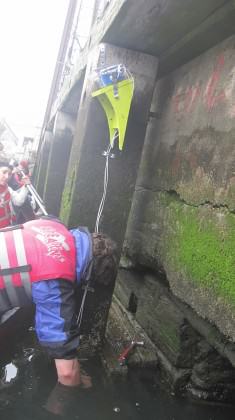
Percifield’s solution is a mix of off-the-shelf gadgets and a good deal of hacking, tinkering, and tactical appropriation of the city’s existing sewer infrastructure. Percifield has asked the NYC Department of Environmental Protection (the “DEP”) for permission to install water quality sensors at a handful of sewage outfalls, and this spring he worked with a team of like-minded technologists to test the equipment at an outfall on the notoriously nasty Gowanus Canal. The sensors broadcast information about water quality and create a stream of data that can warn New Yorkers when an overflow is taking place.
“These alerts can encourage people to do point-source conservation,” Percifield claims, drawing inspiration from voluntary electricity conservation programs that kick into gear during heatwaves. “Con Edison [the local utility] can contact commercial customers that have signed up and say, ‘We need you to reduce your power for a period of time.’”
Though the DontFlush.Me sensors have yet to be installed, the alert system is already up and running. Percifield designed this first iteration of the system to tap into publicly available weather data and make a best-guess at the likelihood of an overflow in each of New York City’s five boroughs. Real-time updates are available as emails and text-messages, and you can follow DontFlush.Me on Twitter.
As part of his graduate thesis at Parsons, Percifield designed a colored LED light bulb with a direct connection to the Internet – and, of course, the DontFlush.Me datastream. Plug the light bulb into any electrical socket and the color of its glow tells you whether or not it’s O.K. to flush. “I think it’s the beginning of a future where things will provide you with feedback about their impact,” Percifield says. “It’s a piece of infrastructure that can engage people more actively in their daily lives.”
Percifield admits that DontFlush.Me is just one part of a comprehensive strategy to clean up New York’s waterways, making them safer for swimming and fishing – and, potentially, for any creature that would thrive in cleaner waters. DEP is making significant investments in bricks-and-mortar infrastructure to upgrade the sewage system. At the same time, community groups are planting trees, rain gardens, and green roofs to trap stormwater and prevent it from overwhelming the city’s treatment plants. In the process, they are creating habitat and transforming urban ecosystems. Both halves of the cyborg are being tweaked here and there to better work together as a whole system.
Our knowledge of what works in managing rural places doesn’t always port over to the living systems we’re fostering in the city. Robert Sullivan tells of ecologists at the NYC Parks Department discovering that roofing material and plywood – illegally dumped in the city’s out-of-the-way open spaces – make great habitat for snakes. So, sometimes, they leave it alone. If the snakes like it, maybe it isn’t such a big deal. Time will tell. “Smart city” projects like Percifield’s can help us practice a sort of minute-by-minute adaptive management in these cases. New data streams can tell us whether or not we’re doing more harm than good as we muddle through with our environmental initiatives. They may also welcome every city dweller to participate in that adaptive management process, tweaking day-to-day interactions with urban ecosystems and immediately getting feedback on the results. DontFlush.Me may be connected to the sewers, but ultimately its about the relationship between New Yorkers and the harbor estuary that surrounds their city.
Since starting his project in early 2011, Percifield has only been down inside New York City’s sewers twice. Once, he ventured down a manhole with Steve Duncan, an urban explorer with a penchant for wandering into the forgotten nooks of NYC infrastructure. Early in the development of DontFlush.Me, Percifield planned to install sensors directly in the underground pipes to monitor water volume (the idea was later nixed by engineers at the DEP). Though anyone can tour the sewers of Paris, New York’s subterranean waterways are off-limits to the general public, and Percifield has yet to pop another manhole cover.
Another expedition took Percifield straight into the mouth of a large sewage outfall in Brooklyn. Rowing in a tiny boat, he floated under the bulkhead and into a cavernous concrete chamber. “In some places it’s about 18 feet across and five or six feet high,” he recalled. “You’re talking about a space the size of a two car garage.” On a rainy day, these massive outfalls create a frothy Niagara of sewage and street litter. It’s a sight that few New Yorkers would willingly witness for themselves. Soon they won’t have to. The cyborg is learning to speak, and it’s telling us how to help it work better.



Leave a Reply