

India already has a legal framework to protect mangroves. The challenge is making that protection meaningful. Compensatory plantation should not become a substitute for avoiding the destruction of mature mangrove ecosystems.
Over two thousand years ago, Tamil Sangam poets mapped the world into five ecological zones, one of which was the coast. They called it Neithal-the coast.
I was reminded of this when I visited Muthupettai in Thiruvarur district, Tamil Nadu, on 25th March 2025, as part of background research for Azim Premji University’s annual climate festival Coast and Oceans of Life.
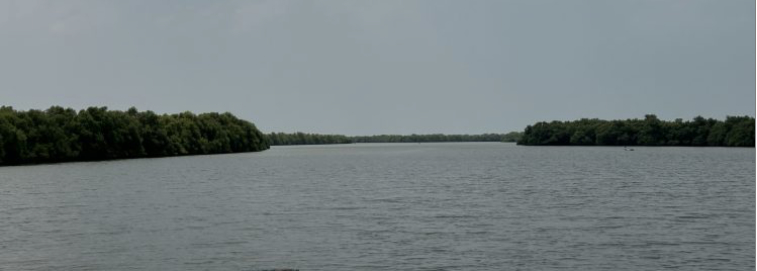
Muthupettai is a quiet coastal town where fishing communities, agricultural landscapes, and cultural heritage are closely connected to the coast. Beyond the town lies a vast mangrove landscape of mudflats, lagoons and tidal channels. Its 120-square-km mangrove forest is part of a Ramsar site. The Muthupettai Lagoon, also known as Mullipallam, is a metre deep and can be reached only by boat.
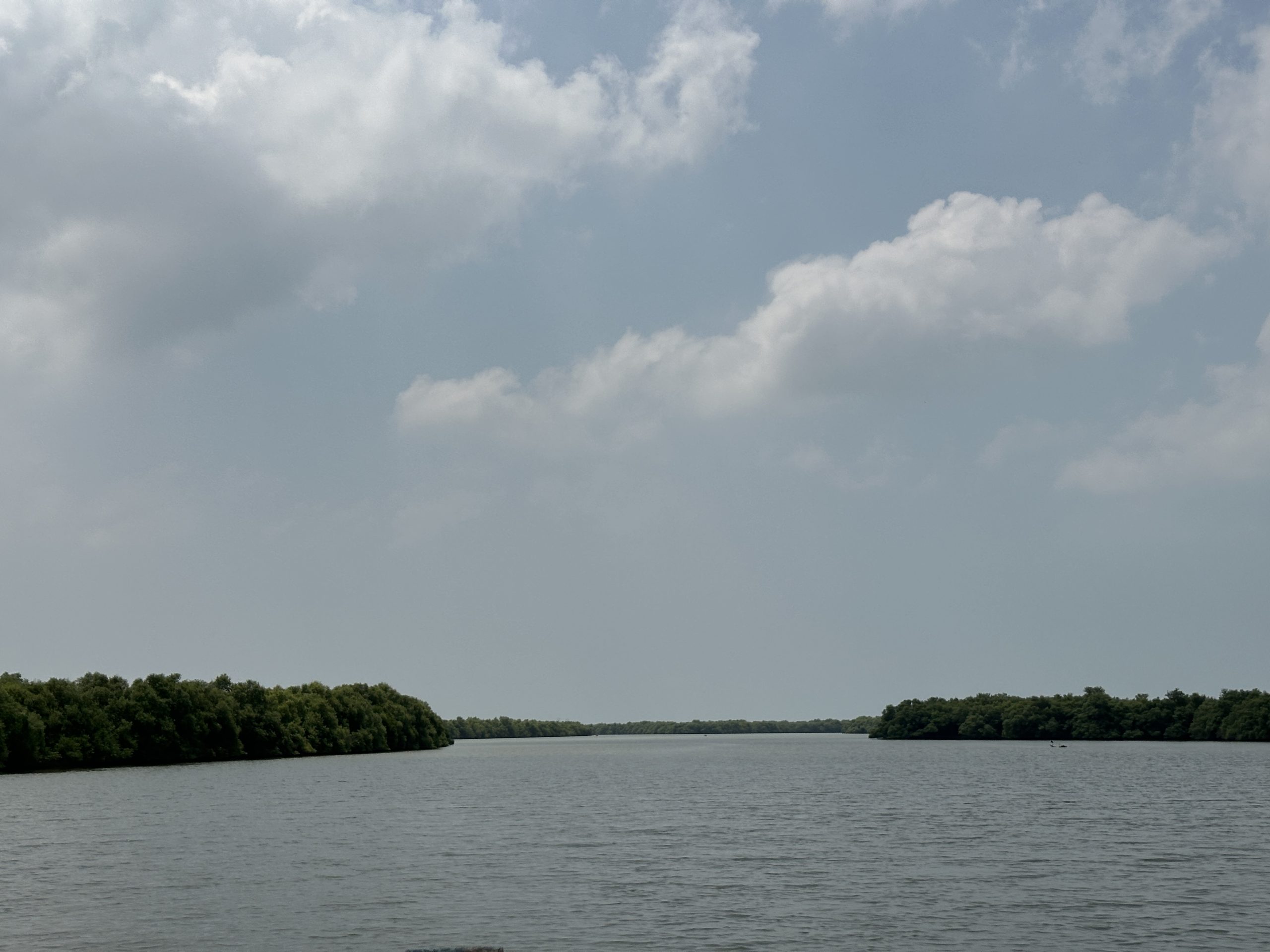
As our boat moved through the lagoon, the mangrove roots beneath the water appeared as an interconnected network. The landscape was calm and quiet, but it was clear that it was full of life. The 700-year-old Muthupet Dargah stands as a symbol of shared heritage and communal harmony.
India has about 4,992 sq km of mangroves spread across nine states and four Union Territories. These ecosystems store carbon, protect coastlines from waves and storms, and provide nursery grounds for fish and shellfish that support coastal livelihoods. But they are also increasingly under pressure from coastal development, pollution, and climate change.
This creates a contradiction in India’s coastal policy. Mangroves are legally protected under the Coastal Regulation Zone (CRZ) framework. The CRZ Notification classifies mangroves as CRZ-IA, where most activities are prohibited. Yet the same notification allows roads and other public utility projects in CRZ-IA areas under exceptional circumstances, subject to environmental clearance and compensatory plantation.
Mumbai is the most recent and visible example. The 26-km Versova-Bhayandar coastal road received CRZ clearance from MoEFCC in November 2024, followed by Bombay High Court permission in December 2025. In March 2026, the Supreme Court upheld both, accepting the road as a public utility under the notification. Around 45,000 mangroves classified as CRZ-IA are expected to be cleared, with compensatory planting elsewhere offered and accepted as mitigation.
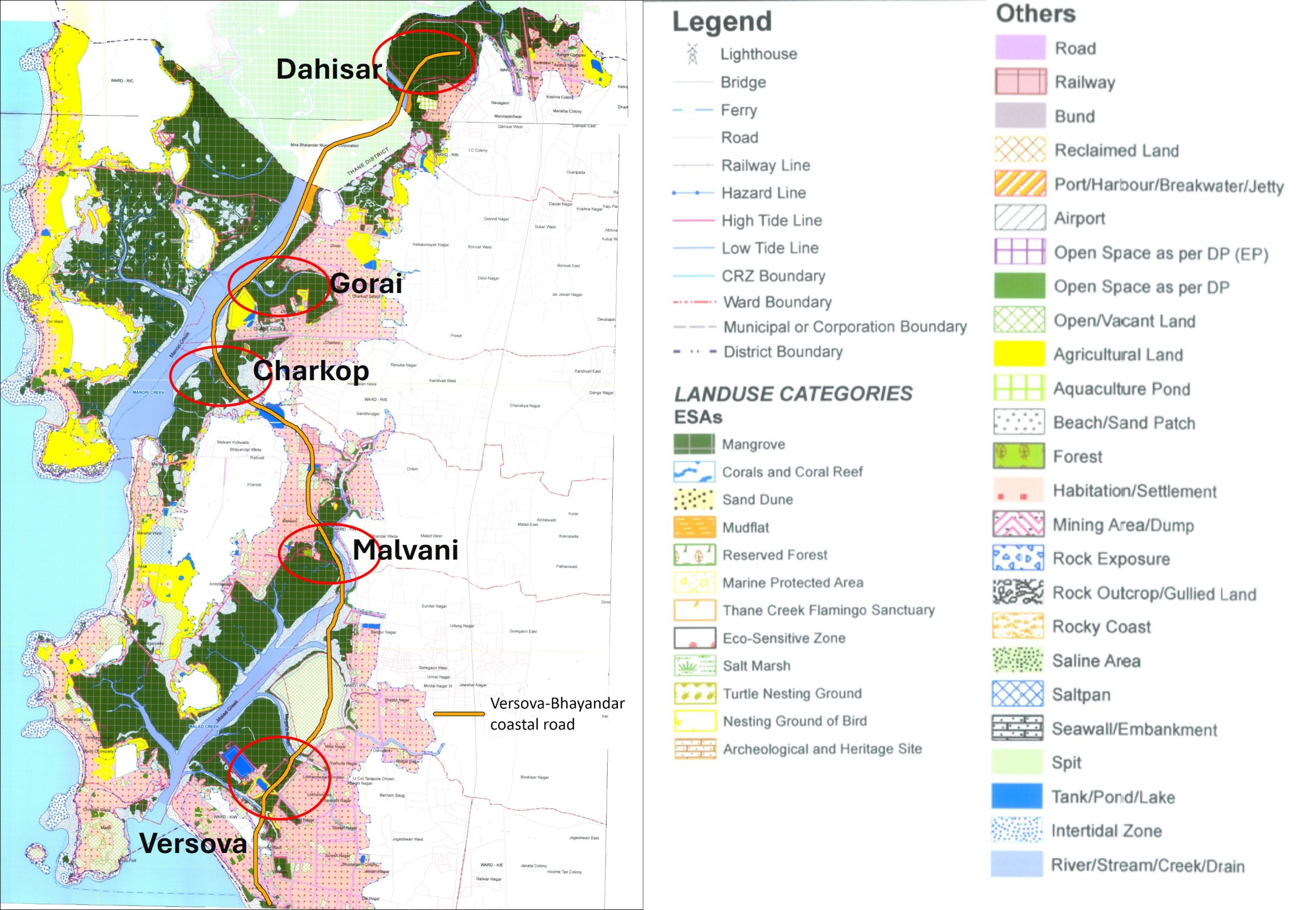
The CRZ map of Mumbai’s western suburbs shows extensive mangrove cover (dark green), classified as CRZ-IA, along the coast from Versova through Charkop, Malvani, Gorai and Dahisar. The orange line shows the proposed Versova–Bhayandar coastal road alignment. The road alignment was overlaid on the CRZ map.
This raises a fundamental question: can a mature mangrove forest in one location really be replaced by planting saplings somewhere else?
A mature mangrove forest is more than a collection of trees. Its roots, sediment, tidal waters, microorganisms, and wildlife form a functioning ecosystem that develops over decades. A mature forest can be cleared in days, while a replacement plantation may take decades to provide comparable ecological functions.
The problem is visible elsewhere too. In Gujarat, a Comptroller and Auditor General (CAG) audit reported 117 hectares of mangrove destroyed and violations in CRZ-I areas. In Tamil Nadu, a CAG audit found that mangroves were removed during construction of Mudhunagar Fishing Harbour with no compensation measures indicated in the clearance. Kerala has lost more than 90 percent of the state’s historic mangrove cover, much of it to infrastructure and land reclamation.
Yet, Muthupettai tells another story.
During my visit to the Tamil Nadu Forest Department office, I met forest officer Mr. Srinivasan, who explained how the department worked with 10,000 villagers to restore degraded mangrove areas. By digging canals and bringing tidal water back into barren land, the initiative regenerated 2,057 hectares between 2022 and 2025.
The Integrated Mangrove Fishery Farming System practiced there combines aquaculture with mangrove restoration, enabling local communities to generate income while conserving mangrove ecosystems.
Similar approaches are being followed in other places. In Pichavaram and along the Thanjavur-Pudukkottai coast, women from fishing communities are involved in raising and protecting saplings. In Odisha, fisherwomen are replanting mangrove saplings driven by living memory of the 1999 super cyclone that swept away everything. In Gujarat, collaboration among government, communities, and private actors has restored thousands of hectares.
What I saw at Muthupettai sits alongside these stories. It is that mangrove protection works best when the ecosystem and the people who depend on it are treated as part of the same system.
India already has a legal framework to protect mangroves. The challenge is making that protection meaningful. Compensatory plantation should not become a substitute for avoiding the destruction of mature mangrove ecosystems. Environmental assessments must also consider what mangroves contribute to coastal protection, fisheries, carbon storage, and local livelihoods.
The Natrinai, one of the earliest Tamil anthologies, captures coastal life in a single line: “Peruneer vilayil em siru nal valkai” — Our simple but meaningful life depends on what oceans provide. The mangroves were part of that world: the tidal forest that fed the fish, protected the shore, and kept the land in place. The irony is that we have forgotten what those poets knew: the coast is not empty land—it protects and sustains life. The question is whether we will protect the ecosystems that have protected us for centuries.
Vivek Ganesh
Bengaluru


Leave a Reply