

Perhaps “Why not here” is the question we should all be asking as we re-imagine urban nature in the places we love. As we contemplate a greener urban future, our cities needn’t be constrained to the mythologies that have characterized their past.
“Cities have mythologies”, a colleague mentions offhandedly.
There are the smart cities, turning to technologies to improve essential services and respond to challenges. The global cities serve as pivotal nodes in economic networks. There are cities that view themselves as superior ― the ones that nobody wants to leave, but that can overlook their own problems, because “that could never happen here”. There’s the scrappy, grassroots urbanism of my own adopted city of Montreal, with its preponderance of small public spaces and local greening projects.
We’re having this conversation in Windsor, Ontario, Canada’s southernmost city. And maybe it’s Windsor (the “Automotive capital of Canada”)’s gritty, blue-collar mythology that led so many of my fellow Windsorites to question my choice to leave and study ecology almost 2 decades ago. “The environment? Really? Not a lot of jobs for that down here,” was a common refrain during visits home, my first few years of university. (I was studying in nearby Guelph, and squarely in line with that city’s “hippy” mythology, I had arrived a med-school hopeful, and emerged a few months later as a vegetarian, buy-nothing-day-organizing, environmental biology student). A historically significant hub for the car industry with a rich industrial and manufacturing heritage, Windsor isn’t necessarily a sought-after destination for environmentalists. Indeed, the Windsor region consistently scores near the bottom of the country in measures such as tree cover and access to nature, feeding the well-meaning concern that my chosen degree wasn’t exactly opening a lot of pathways back home.
To my detractors’ credit, I never did move back after my decision to leave 18 years ago; I am happily settled into a career as an urban ecology professor in Montreal. A choice, however, that has more to do with the vagrancies of the academic job market than either Windsor or Montreal per se. And on this recent visit to my southern Ontario hometown, I was thrilled to discover that the narrative is changing… I think… I hope. The Windsor mythology I grew up with seems to be fraying, just ever so slightly, at the seams.
Or maybe it’s me who’s changed, and years of studying the nature of cities have simply allowed me to look at this one with new eyes.
I visit my hometown frequently, but this trip was my first in a professional capacity ― at least since I worked here as a summer research assistant at 20 years old (a job involving a lot of processing of fish samples in a basement lab… which surprisingly was still not enough to turn me off of my environmental trajectory). I’m here on a brief stop during a year of research leave, visiting the Windsor Law Centre for Cities (C4C) and colleagues from the University of Windsor’s National Urban Parks Hub. It’s over lunch at the C4C that we discuss mythologies ― part of a wide-ranging conversation around housing, nature, and the importance of mid-sized cities for moving the needle forward on urban sustainability.
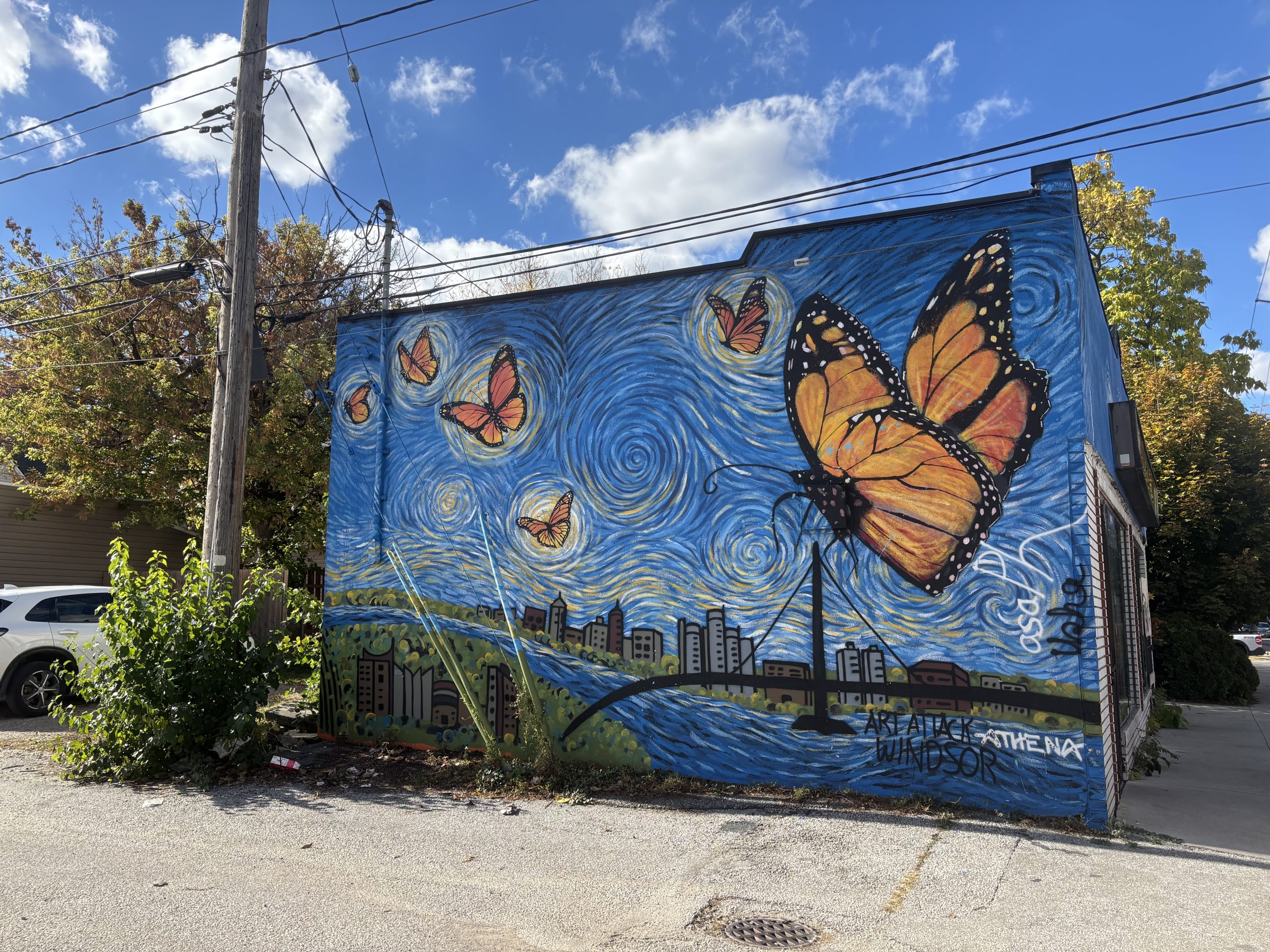
Windsor’s mythology has certainly never revolved around nature, evidenced by the lack of green space for a city located in one of Canada’s biodiversity hotspots. But coming back here wearing my urban ecology hat, I can’t help but wonder why that is. Because amidst the roads with too many lanes ― I borrowed my dad’s car to drive to that university lunch on an 8-lane “stroad” ― and the sprawling new housing developments popping up in former agricultural fields, I’m struck by the incredible natural gems hidden throughout this southern Ontario border town. The Windsor-Essex region is one of North America’s best bird-watching locations and is home to stunning monarch butterfly migrations. It’s situated in the increasingly rare and incredibly beautiful Carolinian forest region. Why isn’t the local nature more central to the city’s vision of itself?
Consider the Ojibway Prairie Complex. As I’m guided through a remnant patch of tallgrass prairie with my friend and colleague Catherine Febria (of the Healthy Headwaters Lab), I can’t help but marvel at this expanse of late-fall goldenrod, punctuated by scattered oak trees in the adjacent savanna. These plants grow precisely where their ancestors have always lived. There used to be a million square km of tallgrass in North America. What we’re left with now is a small fraction of one percent. I often attribute my personal love of prairies to my time in Madison, Wisconsin, during graduate school ― a city whose own mythology includes a strong ethic of prairie conservation ― or to summer days in Saskatchewan visiting my in-laws. As the late-morning light streams through the orange-brown leaves of Ojibway’s oak trees, I’m not sure how I’ve largely overlooked that some of Canada’s most important prairie sites are right here in Windsor, just a few km from my childhood home.
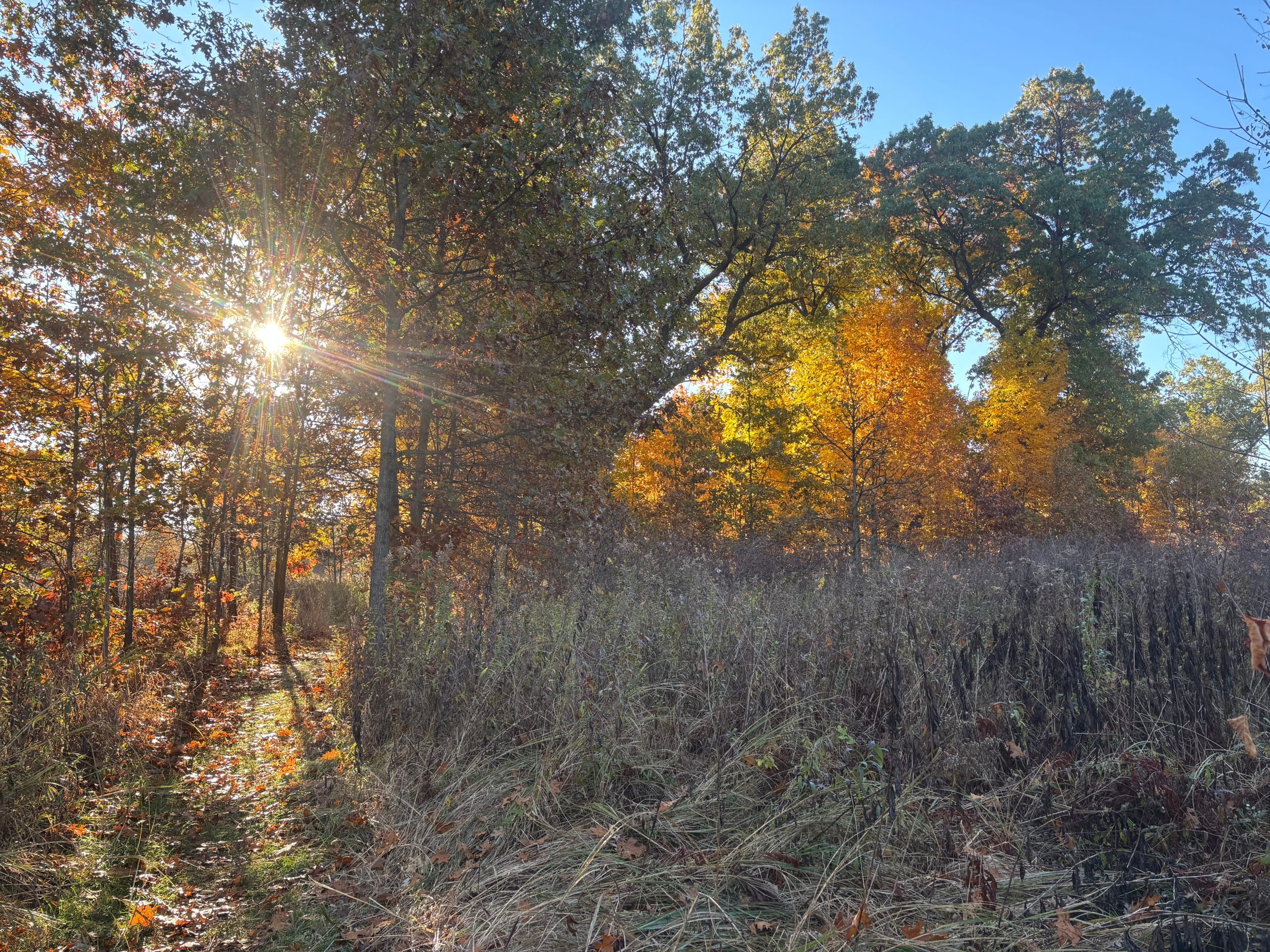
This site ― part of the land hopefully slated to become one of Canada’s inaugural National Urban Parks ― is home to plants and animals no longer found anywhere else in the country. It is also a place of deep history for many communities in the region and has been heralded as a potential “springboard for Indigenous-led conservation, and the poster park for sustainable development against all odds”. What better place to achieve the nascent National Urban Park policy goals of furthering connection to nature, conservation, and reconciliation?
As I reflect on the nature still left in this city, I also can’t help but also think about the need for this nature in a city that already experiences 20 days per year over 30°C and is barreling towards 80 such days in my lifetime. A city subject to the same inequities with respect to trees and shade that we see in cities globally. I see this sentiment that nature must be protected reflected back to me the next morning from an article in the local Windsor Star ― “Advocate seeks renewed action on Ojibway park” ― staring up at me from my parents’ kitchen table.
Will this much-awaited and strongly supported park actually materialize? And can a new National Urban Park help reshape a city’s mythology?
Over the course of my two weeks here, I’m struck by the growing number of people fighting not only for lasting protection of the Ojibway Prairie Complex, but for Windsor’s nature more broadly. I visit the stunning Freshwater Restoration Ecology Centre on the shores of the Detroit River, where endangered freshwater fish species are prepared for re-introduction to Windsor’s waterways. As I play outside with my 3-year-old nephew, my brother points out the new sapling outside his house – planted under the city’s very first urban forest management plan. Following a talk on “Repair, Resistance, and Reimagination of Urban Nature” ― part of the reason I’m back home in the first place ― I hear from citizens who want to revive downtown community gardens. There is a lively discussion on how nature-based solutions can contribute to growing food insecurity. A member of the local Indigenous Youth Circle discusses how to grow an ethos of stewardship for the city’s natural spaces. A student tells me that they’ve never attended a public event like this, but they’re glad that they came. A second student is bursting with enthusiasm to start a restoration program at their local park.
This is feeling very different from the Windsor I knew at their age.
Repair. Resist. Reimagine.
It’s clear to me that while there’s a long way to go, the process of repairing the relationship with nature has already begun in corners of this city, prompted in part by the resistors ― critical advocates who have never given up on this city’s potential. But what I find myself most drawn to is re-imagining. With a changing climate and ongoing urbanization, the cities of the future will be fundamentally different than today. I strongly believe that the stories we tell shape the kinds of futures we can get to, and I’m thinking about the kinds of positive nature visions I can tell when I talk about my hometown.
Meanwhile, on our walk through the prairie and along the nearby Turkey Creek, Catherine is thinking about this too. An adult transplant to Windsor, she doesn’t like to perpetuate the typical industrial, auto-centric mythology. She ― correctly, refreshingly ― describes the city instead as a place of innovation. This is a place where people have always rolled up their sleeves to do the hard work that needed to be done. So why shouldn’t this region be a center of environmental solutions?
As we discuss a new vision for the future of Windsor, she takes it a step further than even I’ve imagined. “Why shouldn’t Huron Church Road be a river again?”, she challenges, referencing one of the many lost rivers in the region, running below parts of a major thoroughfare. “It might take generations, but we can plant the seed now. They did it in Seoul, so why not here?”
Perhaps “Why not here” is the question we should all be asking as we re-imagine urban nature in the places we love. As we contemplate a greener urban future, our cities needn’t be constrained to the mythologies that have characterized their past.
Carly Ziter
Montreal


Leave a Reply