


The community uses the tree of life to symbolize the liveliness of their love for their missing family members, and as a call to stewardship of the garden and their community now, and a statement of commitment to a better, less violent future.
Trees ― living, dead, and transformed ― play roles in the lives of three communities in New Haven, CT. Because trees themselves have life cycles, interact with other living and non-living actors, and have material and symbolic significance, they are central to the lives, livelihoods, wellbeing, and creation of meaning in various communities of people.
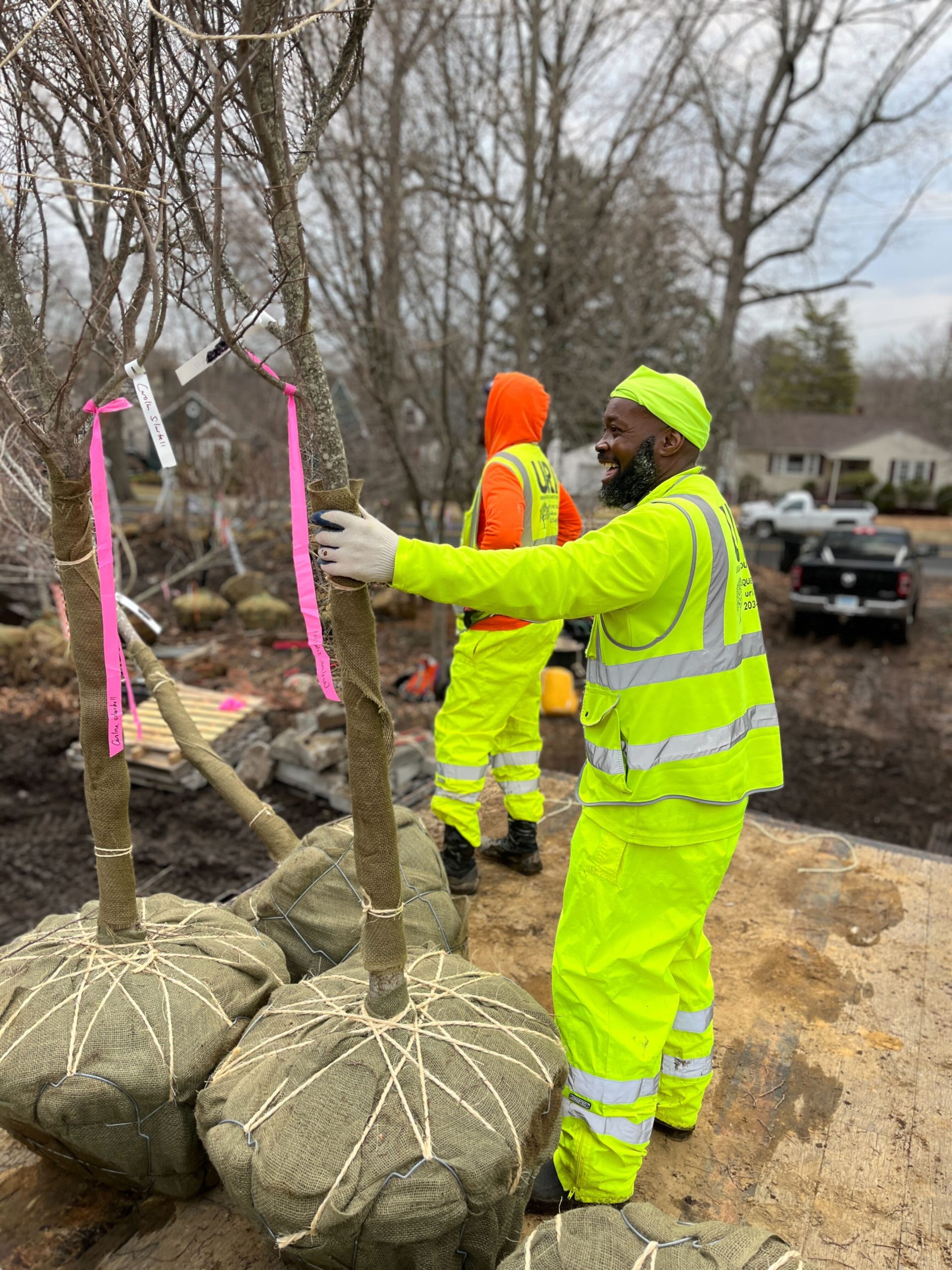
The community of tree planting and care is the first community we consider. New Haven, a very old city in which heavy industry was important for 200 years, has become what many people would call a post-industrial city. Of course, as the home of Yale University, the business of education, along with biotechnology and precision manufacturing in small firms, represent important economic opportunities for many. But the descendants of the Great Migration of African Americans from the American South, or European-Americans whose grandparents and great-grandparents staffed the now shuttered heavy industries, live in neighborhoods that often lack many of the amenities that characterize New Haven’s wealthier neighborhoods, or places that have been gentrified or maintained to serve those who provide or seek the world-class education for which the town is internationally famous. It is in the underserved neighborhoods that the Urban Resources Initiative (URI) works with individual households to provide street trees if they desire them. URI partners with the city of New Haven and other non-governmental organizations to provide and plant those trees free of charge to the residents.
The community might seem to consist of the householder “clients”, URI as an organization, and the relevant agencies of the city. But the community also includes the staff of URI. Many members of the tree planting team have been employed for long periods by URI but previously had not been trained for gainful and purposeful employment, or had often faced other barriers to employment. URI as an organization provides the skills that facilitated people’s entry into the workplace and longevity as productive wage earners. These services are made available to other residents who might benefit as well. High school students also are gainfully employed in the tree planting community. This community is trained in tree biology and ecology, and in the actually quite technical process of planting trees in infrastructurally complex streetside habitats. It is much more than digging a hole and rolling a tree root ball into the void. The hole must be constructed to match the size and configuration of the root ball. The bottom of the hole must be shaped to help spread the roots beyond the extent of the burlap-encased root ball. Finally, the tree must be precisely leveled and staked. The householders agree to water the tree for two years. The tree team visits each tree within its first year to check for mortality or damage.
Interns from Yale University and graduates of what has for decades been called “the forestry school”, but is now officially the School of the Environment, join the tree planting team and help train other employees, including the high school students. Exposing youth from underserved neighborhoods in New Haven to reliable employment, to professions and careers that may not be represented in their neighborhoods, and to the field of urban ecology extends the community into the future.
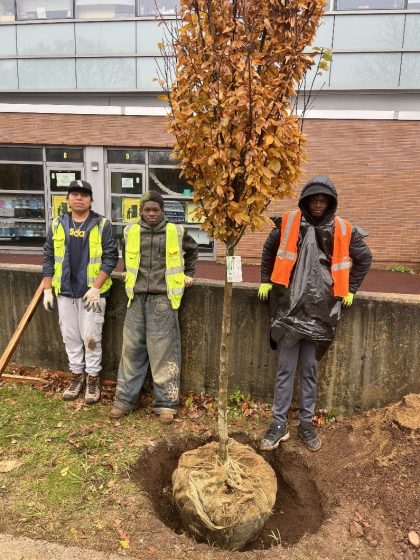
The often-underserved neighborhoods that URI supports with tree planting and knowledge benefit from the now familiar amenities and ecological services of trees. A single block often is home to several trees planted by URI. This illustrates the intangible local community that grows around URI tree planting and is a positive kind of “keeping up with the Joneses”.
The community of harvest is the next “stop” on our tree community tour. Although some species of trees in favorable ecological and social situations can live for centuries, all trees eventually succumb to old age, wind or ice storms, insect pests, drought, or damage from human activities. Large fallen limbs, uprooted trees, pruning debris, or entire trees that must be removed for new construction of buildings or infrastructure represent the other “end” of the cycle started by planting. The downed timber and smaller remnants of trees are often regarded as waste, to be chipped for mulch or interred in the limited volumes of landfills. However, if these materials are treated as resources, they can provide benefits and support communities well beyond the use of small-dimension firewood.
The lumber yard of City Bench is filled with piles of logs, stacks of long planks, and some random-looking piles of odd-shaped remnants. City Bench recovers downed trees and timber from New Haven, including some from the Yale campus, and other municipalities in the state of Connecticut. This material is first air dried, then moved to an indoor kiln for further drying. The planks, sawn and finished, are used to create elegant furniture for sale. Their clients include private collectors and institutions seeking signature or commemorative pieces. Some of their public products include benches installed in New Haven neighborhoods to spark conversation among residents and help build social connections and a sense of place.
Some of the wood is destined for an 800-strong subscription-based community workshop called MakeHaven. Here, residents find welcoming space to work in wood and other materials, shared equipment that few individuals could afford on their own, and a community of creators to learn from, share expertise and advice, and participate in the joy of making together.
A third aspect of the end life of trees was introduced by Aspen Golann, a world-class furniture maker and award-winning artist in wood. She pointed to one of those random-looking piles of wood in the City Bench lumber yard and said that would be where she would likely find her preferred green wood for making furniture. She emphasized that even green wood, harvested from freshly fallen trees or limbs, has a long-standing use in the craft of furniture making. Because green wood has not been dried, it remains flexible and can be used with traditional hand tools and knowledge of wood-to-wood joinery that does not use industrial metal fasteners. Such pieces, including Windsor chairs or benches, are an ancient craft that continues to bring wood and people together in community today.
This community, centered on the mid- to end-of-life state of trees, includes people who prune older trees, collect the moribund and fallen trees, and use the wood to support an economy rather than burden a waste stream. This human community engages an ever-widening network that is sustained and nourished by the traditional and modern crafts of wood working. This community makes things not only for the wealthy, but also for ordinary people and neighborhoods.
The community of healing brings us full circle from planting. Four mothers, Marlene, Pamela, Celeste, and Winnie[i], who each lost a child to gun violence in New Haven, established the New Haven Botanical Garden of Healing. They did this with the help of the Urban Resources Initiative and built partnerships with the city and other organizations to ensure that the garden would be a sustainable living memorial and to serve as a cultural and spiritual resource for the community. But it is also a place to educate people about gun violence, and to encourage policy and practical action to reduce that risk.
There are many elements of this profound and harmonious place. There is an emotionally evocative memorial path in which bricks are set, naming the victims and their age at death. The parents of the victims are invited to participate in a ceremony placing their loved one’s brick. But in a prominent place beyond the end of the memorial path stands a handsome dwarf beech tree, representing the tree of life. Around the tree are circles of benches for meditation, quiet conversation, or education. A low stone wall sets off this area, and bears inscriptions recalling some of the dreams and pleasures of those whose lives were cut short.
The community uses the tree of life to symbolize the liveliness of their love for their missing family members, and as a call to stewardship of the garden and their community now, and a statement of commitment to a better, less violent future.
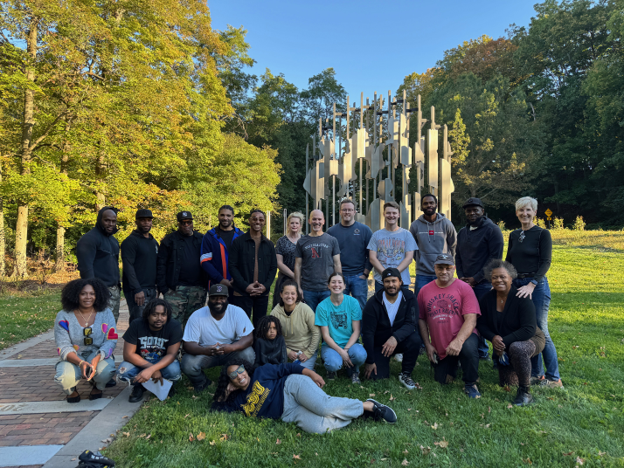
Coda. This essay recounts impressions and actions that center on the role of trees, their care, their meaning, and their contribution to various, and sometimes overlapping, human communities in New Haven. In all of these communities, the loving care of trees and the needs of human communities have been seen to be linked. The metaphor and image of the life of trees and their connections is powerfully linked in these communities. There are communities centered on planting and establishing trees where they are both needed and wanted. There are communities who treat harvested trees and timber as precious and generative materials for people and society. And there is the human community of rebirth and continuity in the face of tragedy, centered on a restorative garden and its signature tree. The symbol and growth of trees tie unexpected aspects of cities and nature together in a resilient community that grows from shared respect and shared work.
Steward Pickett, Colleen Murphy-Dunning, and Morgan Grove
Poughkeepsie, New Haven, and Baltimore
Notes
This essay was based on a transdisciplinary Urban Ecology Field Trip in New Haven, Connecticut, in November 2025. This trip exposes students in the transdisciplinary urban ecology class at the Yale School of the Environment to activities and projects that combine the practical knowledge of ecology with the concerns, commitments, and activities of communities in the city.
We happily acknowledge that the positive views of trees and the variety of urban projects that join trees and diverse human communities are not unique to New Haven. We merely wish to record our pleasure in the synthesis of different ways to view and use urban trees culturally, economically, and ecologically to create and serve the wide range of human communities of urban places.
References
New Haven History: https://stevehamm31.blogspot.com/2019/06/ghosts-of-industry-new-havens-mill.html#:~:text=New%20Haven%20has%20been%20in,photo%20from%20his%20web%20site.
Urban Resources Initiative: https://environment.yale.edu/research-impact/centers-programs-and-initiatives/urban-resources-initiative-uri
City Bench: https://city-bench.com/
MakeHaven: https://www.makehaven.org/
Aspen Golann, furniture maker and artist: https://www.aspengolann.com/
The New Haven Botanical Garden of Healing: https://uri.yale.edu/programs/greenspace/groups/new-haven-botanical-garden-healing-dedicated-victims-gun-violence-5
[i] Winnie has since passed.

Leave a Reply