



By expanding how we think about garden security, from ownership to access, capacity, and intentionality, we arrive at a more grounded understanding of what is required for gardens to endure.
On one block in Philadelphia’s Norris Square neighborhood, there were three active community gardens in 2019. Five years later, in the summer of 2024, only one remained. One former garden has been replaced by a pristine vinyl-sided rowhome, its backyard fenced in and partially paved to make way for an expansive patio. According to online records, the land sold in 2020 for $60,000, and when the house was completed in 2022, it sold for $464,000, far above the neighborhood median of $150,000.[1] One of the other gardens on the same block has not been developed, but it is no longer active. Few signs of the once vibrant space remain. In its place, a wild mix of goldenrod, chickweed, mugwort, and burdock have taken root.
These two outcomes, development and abandonment, are not unusual. Across the city, gardens are lost to both rising development pressures and to the gradual breakdown of the conditions needed to sustain them. This block serves as a microcosm for a broader pattern of community garden insecurity across the city. In 1996, Philadelphia was home to over 500 community gardens, but over the past 25 years, more than a fifth have been lost.[2] Between 2019 and 2024, at least 50 gardens were lost, bringing the total number of confirmed active community gardens in the city down to 387.[3] Yet over this same period, the Philadelphia Garden Data Collaborative (PGDC) also documented 43 previously unrecorded gardens, a reminder that community gardens are not only being lost but also continually emerging, often informally, in ways that themselves contribute to long-term insecurity. Many of the lost gardens were displaced due to property speculation and development. However, an equivalent number were abandoned or left untended. These numbers highlight a puzzle for urban garden security in post-industrial cities like Philadelphia: although it is critical that gardens have sustained access to land to grow on, long-term garden security is a more complex story. Here, security refers not to physical safety, but to the conditions that enable or constrain a garden’s continuity over time. Since 2015, the PGDC, a partnership of researchers, legal advocates, garden support organizations, and community organizers, has been documenting the status of Philadelphia’s community gardens. A decade of that work makes clear that the conventional framing of garden preservation, focused on securing land ownership, captures only part of what is at stake. Whether a garden persists or disappears depends on the interaction of four dimensions: ownership, access, capacity, and intentionality. Each names a different kind of vulnerability, and each points toward a different kind of support. Together they offer a more grounded basis for understanding how gardens endure, and what it will take to sustain them.
Land ownership
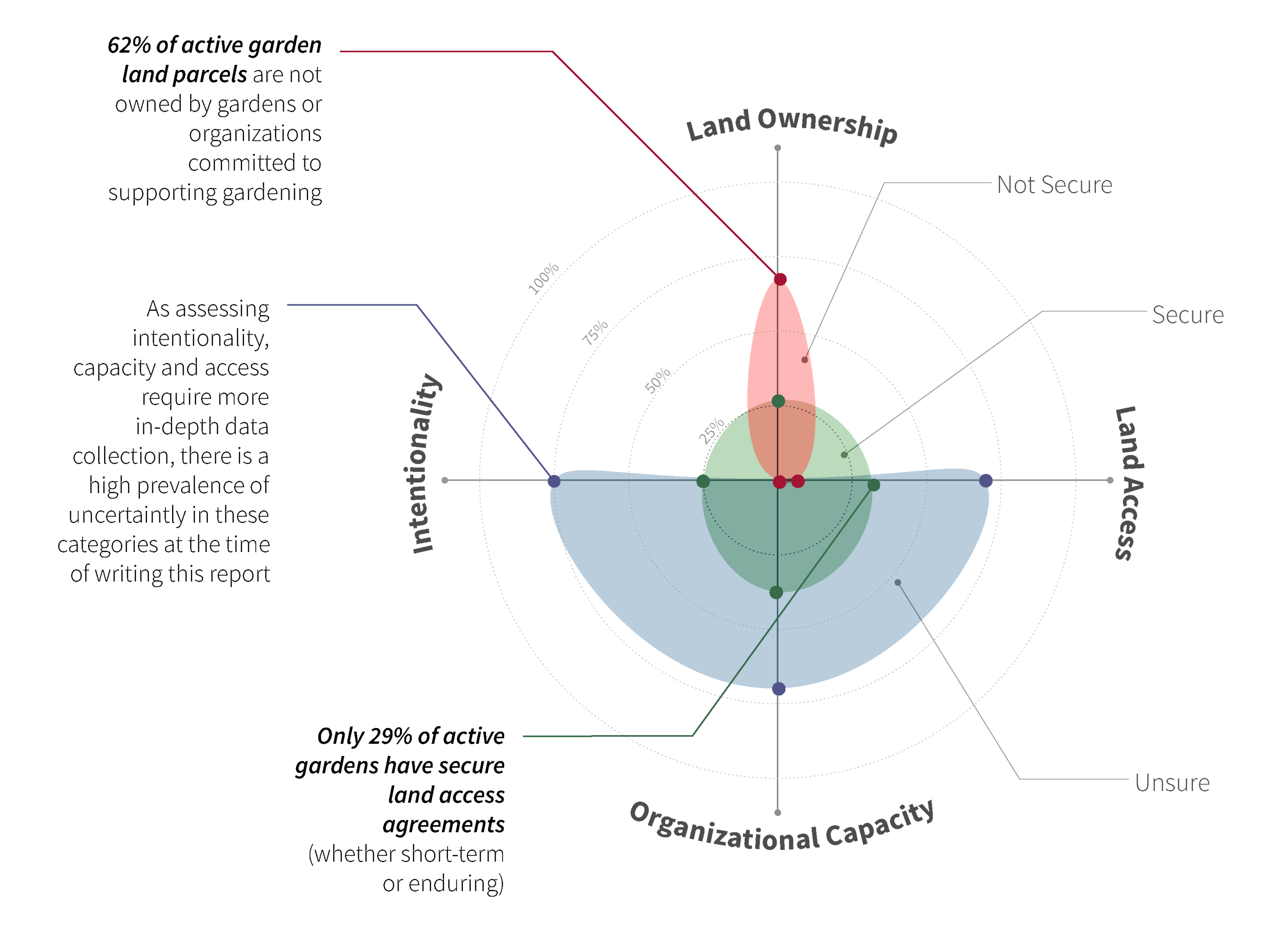
Of the approximately 1,123 parcels cultivated by Philadelphia’s 387 verified active community gardens, only 38.3% have secure land ownership status, meaning nearly two-thirds face potential threats to their long-term viability. In this case, land ownership is assessed by whether the title holder is likely to protect the garden over time. A garden is considered secure when all its parcels are owned either by the gardeners themselves or by a “trusted” organization committed to preservation. Land ownership can sometimes be a burden to gardeners, as it comes with a range of responsibilities and liabilities. In Philadelphia, the Neighborhood Gardens Trust exists specifically to acquire land on behalf of community gardens, but other supporting organizations, including NGOs, CDCs, and Philadelphia Parks and Recreation, may also hold land on behalf of a garden. Land ownership may vary within a single garden, as many span multiple plots, with some parcels secure and others insecure. A garden is considered to have insecure land ownership when even one parcel is owned by an individual or entity without a commitment to long-term preservation.
The insecurity faced by most of Philadelphia’s gardens has tangible effects on both gardeners and the spaces they produce. Gardens can disappear quickly, whether through development or abandonment, and that possibility shapes how gardeners approach the work itself. Building and nurturing a garden often takes place with an awareness that it may not last. Under such conditions, decisions about investment shift, and gardeners may hold back from constructing permanent features or planting perennials. This tension reflects a mismatch in timescales. Plants require years to establish and mature, while land can be bought, sold, and redeveloped in a matter of months.
In Philadelphia, the threat of “sheriff sales” looms heavily over gardens without secure land ownership. These public auctions, used to recover unpaid taxes or defaulted mortgages, treat garden parcels no differently than vacant lots. Fast timelines, limited notice, and cash requirements disadvantage community groups, while well-resourced developers are positioned to acquire the land.
Yet ownership tells only part of the story. A garden with secure land title but lacking organizational capacity or committed stewardship remains vulnerable. Conversely, gardens on insecure land can thrive with strong community support and formal access agreements.
Garden access
While most gardens do not have secure ownership of their land, they still have some level of access that allows them to garden. Access is defined as the ability to formally or informally use land for gardening, whether or not the gardeners own it. This can come through formal mechanisms, such as leases or licenses, or through informal but stable relationships with landowners. The key idea is not just whether access exists today, but whether gardeners have reasonable assurance that they can continue using the land over time.
A critical element in this conceptualization is time. As noted above, short-term arrangements are inherently precarious, as they discourage investment in soil, infrastructure, and community programming. In contrast, long-term arrangements allow gardens to develop and stabilize. Access can be quantified using a scale that captures both the presence and durability of land use arrangements, ranging from no access to short-term agreements (less than five years), to enduring agreements (five or more years).
In Philadelphia, only about 29% of gardens have any confirmed access category at all (whether none, short-term, or enduring). It is difficult to measure land access because, unlike ownership, it often does not leave a clear paper trail. Many gardens operate through informal arrangements based on verbal agreements, long-standing relationships, or tacit permission from landowners, none of which are captured in public records. As a result, these arrangements cannot be reliably verified without direct, on-the-ground engagement with gardeners, which helps explain why such a large share of sites are classified as “unsure.”
Garden capacity
Yet even when access is secure, it does not guarantee a garden’s long-term survival. A garden may have permission to use the land, but without the people, resources, and organization needed to maintain it, that access can quickly become insufficient. What ultimately determines whether a space thrives or fades is the capacity of the people behind it. Understanding this requires shifting attention from land alone to the labor and resources required to sustain it.
A garden’s capacity is a function of the organizational, material, and social capabilities of the gardeners and groups that sustain it. The day-to-day labor extends well beyond planting and harvesting to include site upkeep, conflict resolution, volunteer coordination, and managing relationships with neighbors and city agencies. In many gardens, especially those with limited resources, this work falls on just a few people, which can make sustaining the space over time especially challenging. Gardens with stronger capacity typically have an active team rather than a single overburdened leader, some level of planning beyond the current season, and connections to support networks or partner organizations.
Capacity also hinges on practical infrastructure, including water access. Only about 30.2% of Philadelphia’s gardens have verified water access. Some lack direct water lines and rely on nearby hydrants, which are typically locked and accessible only through neighborhood block captains or other intermediaries. Others depend on informal arrangements with neighbors, running hoses across property lines or carrying water by hand. For resource-constrained gardens, water access can be a daily negotiation that limits what the garden can realistically sustain.
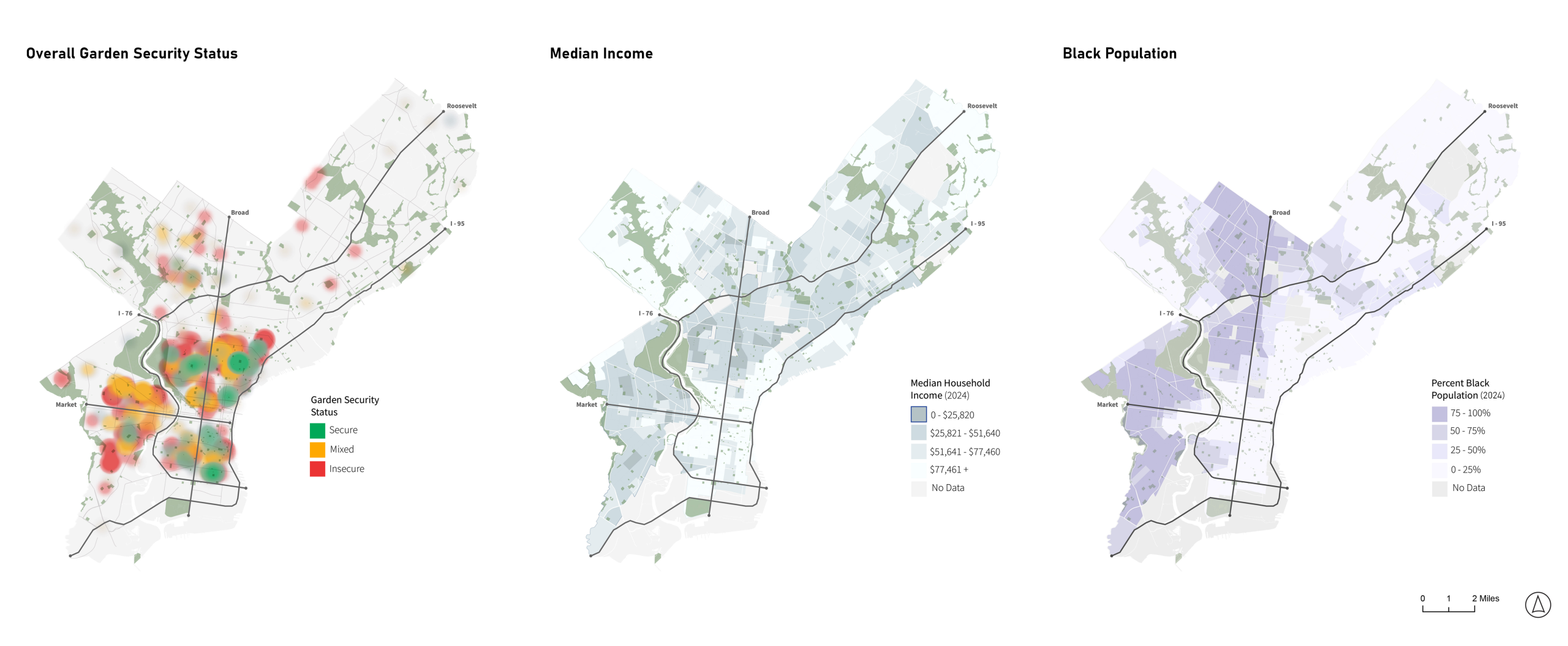
Capacity is also a product of the broader sociopolitical conditions in which gardens are embedded. In Philadelphia, this is particularly evident in neighborhoods marked by long histories of racialized disinvestment, where many gardens are concentrated. Of the city’s 387 confirmed active gardens, 305 are located in predominantly Black neighborhoods. These gardens experience higher rates of land insecurity and tax delinquency than those in other parts of the city, reflecting both legacies of discrimination and ongoing inequalities. In practice, this means that gardens in these neighborhoods are sustained under conditions of greater pressure and fewer available resources, increasing the burden of work required to maintain them.
In such contexts, maintaining a garden often requires more than routine care. Gardeners must navigate shifting policy environments, inconsistent forms of municipal support, and additional administrative and advocacy work that is not evenly required across all gardens. For example, two gardens supported by Neighborhood Gardens Trust have been cited for sidewalk conditions that, while common across the city, carry repair costs totaling around $10,000. For gardens with fewer institutional ties or financial resources, such unexpected burdens can be destabilizing. These pressures reflect a broader pattern in which communities already managing the effects of disinvestment are also tasked with sustaining urban green space. In this sense, capacity is not only an internal attribute, but a product of the political and economic landscape in which gardens operate.
Intentionality
These structural constraints shape what gardens are able to do, but they do not fully explain why some persist while others disappear. Gardens can have land, access, and capacity and still dissolve. Gardeners’ intentionality refers to the depth and durability of the commitment to sustain a garden over time. This aspect is not simply a matter of enthusiasm, but of whether that commitment is organized, shared, and able to endure beyond a single season or a single individual. Many gardens are initiated through the energy of one or two people. When that energy is no longer available, the garden can quickly lose momentum, even where the underlying conditions appear stable. By contrast, where commitment is collectively held and embedded in a group, an institution, or a set of ongoing practices, it is more likely to persist despite shocks and changes.
The landscape of intentionality across Philadelphia’s gardens is difficult to see. Not because gardeners lack long-term commitment but because such commitment is not readily legible through available data sources. For roughly 75% of the gardens documented by PGDC, intentionality remains unknown. Making sense of intentionality requires sustained engagement with gardeners and attention to the social relations that underpin these spaces. At the same time, intentionality is not fixed. It shifts as people move, circumstances change, and the demands of maintaining a garden evolve. A space that reflects strong commitment one season may look very different a few years later, particularly when leadership turns over, or collective energy is redirected. Intentionality is better understood as something continually produced through ongoing participation than as a stable attribute that can be measured at a single point in time.
Conclusion
The difficulty of gauging these different dimensions of garden security is not a reason to set them aside. If anything, it points to why they matter. Community gardens are not simply pieces of land; they are sites of social infrastructure where relationships are built, knowledge is shared, and forms of collective care take root. In a city like Philadelphia, they often provide food access, green space, and a measure of stability in neighborhoods that have long been underserved. Focusing only on what is easily measured, such as land ownership, risks missing what actually sustains these spaces over time. Paying attention to capacity and intentionality allows us to see the labor, commitment, and networks that make gardens possible and to recognize where they are most at risk. It also shifts the question of preservation. Rather than treating gardens as temporary uses of land waiting for development, this broader understanding foregrounds them as enduring community assets, worthy of support, investment, and protection on their own terms.
By expanding how we think about garden security, from ownership to access, capacity, and intentionality, we arrive at a more grounded understanding of what is required for gardens to endure. These dimensions do not operate in isolation. Rather, they point to different forms of vulnerability and, in turn, different kinds of support. Some gardens may require land acquisition, others sustained organizational investment, and still others stronger networks of community stewardship. Attending to these differences makes it possible to move beyond one-size-fits-all approaches and toward strategies that are responsive to the varied conditions in which gardens exist. The task ahead is to ensure that these conditions are recognized, supported, and not left to chance.
Madeline Scolio, Peleg Kremer, and Craig Borowiak
Philadelphia, Princeton, and Haverford
Acknowledgements
Research for this article was conducted in collaboration with PGDC partners, including the Neighborhood Gardens Trust, the Public Interest Law Center, Soil Generation, and the Pennsylvania Horticulture Society. It was made possible through the generous support of the William Penn Foundation, the PhilaChange Foundation, Haverford College, and Villanova University.
[1] “2004 N Lawrence St, Philadelphia, PA 19122,” Zillow, accessed January 8, 2026, https://www.zillow.com/homedetails/2004-N-Lawrence-St-Philadelphia-PA-19122/118355798_zpid/
[2] Angie Bacha, “Community Gardens Build Neighborhood Connections. So Why Is It So Hard to Acquire Land?,” Green Philly, December 10, 2024, https://greenphl.com/philly/community-gardens-build-neighborhood-connections-so-why-are-philly-gardens-at-risk/.
[3] This data was collected as part of ongoing work by the Philadelphia Garden Data Collaborative (PGDC), a collaborative comprising academic partners, legal advocacy groups, garden support organizations, and community organizations. Formed in 2016, the PGDC partners with local organizations to collect and maintain data on the status of community gardens in Philadelphia. During summer 2024 fieldwork, our team visited over 700 known or potential garden locations to verify, categorize, and evaluate gardens and their spatial footprints. Beyond the 387 gardens that were confirmed to be active through these visits, the PGDC database includes an additional 169 sites (88 status unclear, 79 untended, 8 no data) that may have once been a garden but could not be verified as currently active.

Leave a Reply