
about the writer
David Maddox
David loves urban spaces and nature. He loves creativity and collaboration. He loves theatre and music. In his life and work he has practiced in all of these as, in various moments, a scientist, a climate change researcher, a land steward, an ecological practitioner, composer, a playwright, a musician, an actor, and a theatre director. David’s dad told him once that he needed a back up plan, something to “fall back on”. So he bought a tuba.
Introduction
In the recent decade, there has been a retreat of democratic processes and, in some cases, a rise of autocracy. Not only in political space, but also in the space for knowledge itself. Across contexts, contributors of this Roundtable describe the same patterns: data restricted or disappearing, research defunded or redirected, scientists sidelined, public dialogue thinned out or shut down altogether, and governments as sources of dis-information. Evidence is inconvenient for autocrats. Debate is inconvenient. In its place comes something more corrosive—the reshaping of what can be said and known. As one contribution puts it, this is a “twisting of truth…to fit political desires”. It is, at the core, corruption. It is bad for people, and it is bad for the planet.
This roundtable starts from that reality. Rising autocracy is not just about governance; it is about knowledge—who produces it, who controls it, and whether it can circulate openly. The work of sustainability and its policy depends on shared facts, public reasoning, and the ability to confront difficult truths about land, inequality, economic limits, and ecological boundaries. When those conditions erode, so does the possibility of action that supports both people and the planet. Several contributors point to the direct pressures—censorship, intimidation, and the rollback of academic freedom. Others ask hard questions of science itself: how technocratic habits, neglect of equity, or distance from everyday life have weakened trust and made science easier to dismiss. Several insist that science (i.e., knowledge) and democracy stand or fall together—and that both require people willing to speak and act.
There are also glimpses of response: defending data and institutions; building new spaces for dialogue; connecting science with communities, movements, and lived experience; joining “knowledge, energy, and passion” in ways that reach beyond the usual audiences.
Taken together, these contributions do not offer a single answer. They offer something more useful: a set of grounded reflections on how to keep knowledge alive—and meaningful—when the conditions for both are under attack.
Rob McDonald is a co-organizer of the roundtable, which is inspired in part by a paper several of us published: Robert I. McDonald, Dagmar Haase, Thomas Elmqvist, David Maddox, 2026. “Uncharted political waters for sustainability,” Nature Sustainability, Nature, vol. 9(2), pages 180-182, February.

about the writer
Dagmar Haase
Dagmar Haase is a professor of urban ecology at Humboldt University in Berlin. She is a guest scientist at the Helmholtz Centre for Environmental Research (UFZ) in Leipzig. She specializes in urban systems analysis. Together with her team, she investigates ecosystem services, green infrastructure, and nature-based solutions in cities.
Dagmar Haase
Is it all just fear-mongering?
We must learn to recognise warning signs of autocratic tendencies and make them public immediately, especially in times of great uncertainty, insecurity, and susceptibility to right-wing populist and autocratic worldviews.
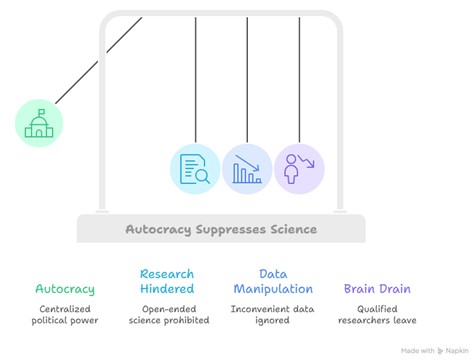
Current societal trends in democracies, such as the rise of autocracy and illiberal democracy, are having a profound effect on climate and sustainability research: They hinder or even prohibit honest, open-ended science that seeks knowledge in a principled and evidence-based way. In such political agendas, sustainability―like many other topics―is subordinated to the seeking or securing of political power, a process which is often supported by groups that are detached from science and reject knowledge. Although autocratic systems could, in theory, enable rapid decision-making on climate, alternative energies, and environmental protection due to their decisiveness and reluctance to engage in open discourse, a lack of transparency, suppression of independent expertise, and prioritisation of short-term goals can simultaneously lead to significant restrictions and a deterioration in living conditions for the population.
The situation of free, open-minded, and knowledge-oriented science in dictatorships is quite comparable to what we are currently witnessing in increasingly autocratic behaviour around the world, including many countries that are actually democracies: the suppression and (self-)censorship of independent research, although often in a subtle and insidious way. Scientists who produce findings that contradict narratives of those following autocratic paths are silenced, defamed, threatened, or prevented from doing their work. Or they are shouted down in public discourse; I have experienced this first-hand as a panellist at a climate change dialogue, despite living in a democratic society!
Research results are politicised, and “inconvenient” data is ignored or manipulated. NGOs and activists who distribute scientific findings to society and put them up for discussion in democracies are no longer supported (which is also happening to some extent in democratic states with increasingly autocratic elements) or, if the autocracy turns into a dictatorship, are banned. This way, research becomes less participatory and loses its connection to the needs of the people. Conversely, the impetus from civil society for research is lacking, which ultimately plays an important role in the legitimacy of science in a democratic society. To present some figures that support my statements: By 2020, one in four articles had been published by scientists from autocratic states in collaboration with authors from other countries. The same applies to more than half of all registered patents and innovations. This is linked to the one-sided outflow of scientific, innovation-related, and security-relevant knowledge, as well as the theft of intellectual property, with the aim of achieving global leadership.
With raising autocracy, research is often directed towards areas that ensure the stability of the government/regime. Long-term sustainability goals, such as addressing climate change, are frequently overlooked in favour of short-term economic growth or (fossil) resource extraction. This leads to the situation we are currently witnessing science in autocratic countries: Increasing isolation and brain drain, all things that we can currently observe. Restrictions on academic freedom cause qualified researchers to leave the country, resulting in a loss of expertise. This hinders international cooperation in climate and sustainability science. And this is where a critical feedback loop is created: In increasingly autocratic systems, access to reliable environmental data is often difficult and strictly regulated, which hinders international and modern scientific work, prevents transparency, and ultimately leads to further brain drain.
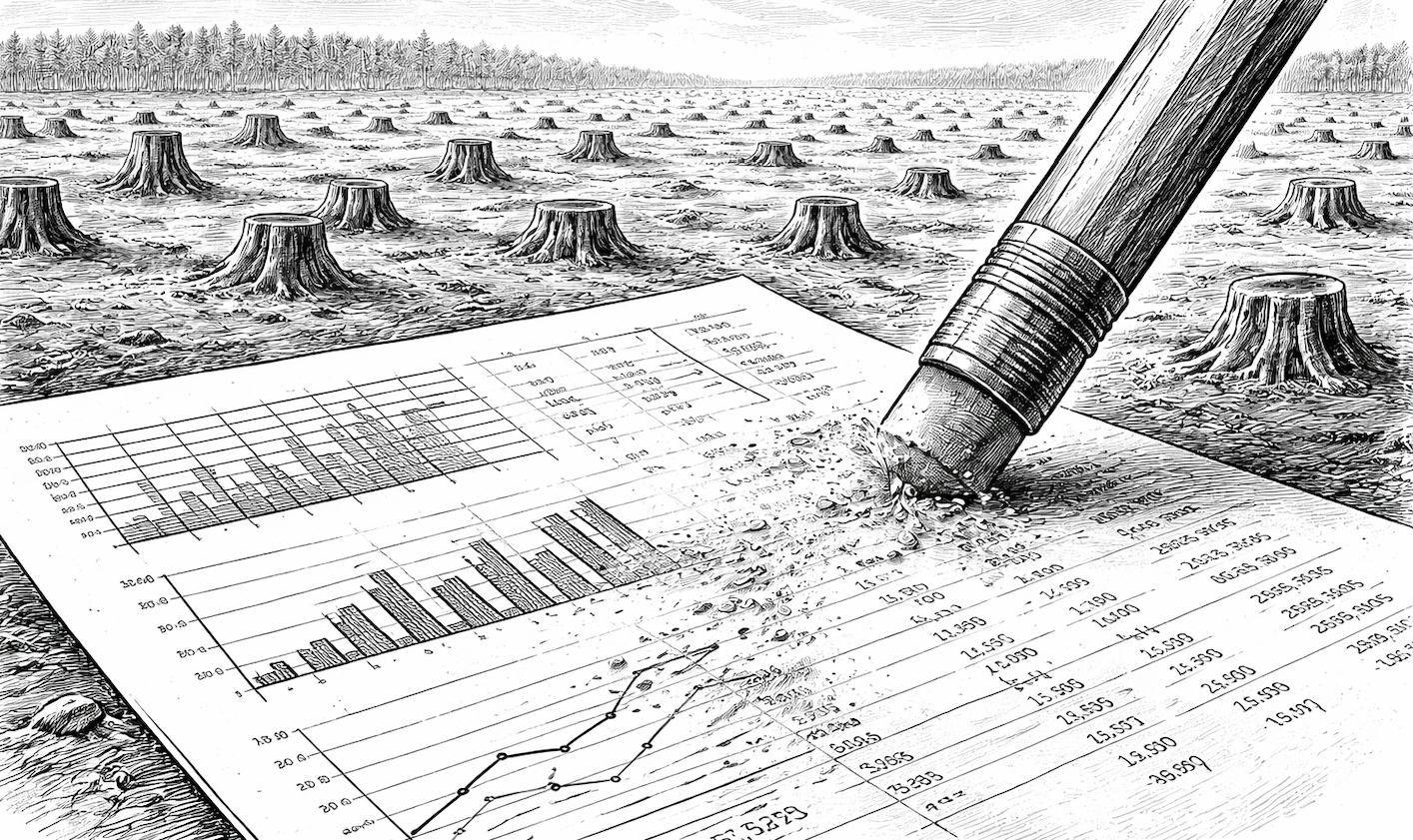
We have described this in our Nature commentary (McDonald et al., 2026) and condensed it with facts and narratives, which there is no space for here. Hence, the following small illustration.
But we must confront ourselves with the question: Could autocracies ultimately be better at protecting the climate and biodiversity because they have the power to force large parts of their citizens to comply? And do democracies fail precisely at this point, since their societies can no longer agree on more climate protection and sufficiency for greater sustainability, as we observe in the EU at present?
I don’t think that’s the case. Quite the contrary, even if the opposite doesn’t seem so obvious: Democracies are often criticised for their inability to meet the challenges of climate change or CO2 reduction. They are said to be too fixated on compromise. Consequently, politics is supposedly hijacked by industries and their lobbyists that would otherwise be affected by measures to reduce climate-damaging emissions. This is particularly true of the fossil fuel industry, as we have seen at the last two COPs, 29 and 30. Another argument is that early democracy and that of the 20th century, including capitalism, are responsible for the majority of historical greenhouse gas emissions, without fairly addressing the fact that these emissions are a consequence of the relative prosperity that capitalist democracies have brought to the citizens of these countries. But are autocracies actually better?
No. While building a consensus is always challenging in democracies, this is offset by the dynamism that characterises democratic societies. Innovations in politics and technology are key to achieving humanity’s climate goals. This capacity thrives in capitalist democracies around the world. Over the past decade, democracies in, e.g., Europe have demonstrated just how difficult it is to implement consistent climate policies in democracies while withstanding autocratic moments. Each time there was a change in majorities and coalitions, there was a more or less radical shift in climate and conservation policies. While autocratic systems can sometimes achieve rapid success in specific technical areas and massive subsidies through centralised control, research shows that democratic countries generally perform better in meeting environmental targets because they offer corrective mechanisms and public participation.
But what can we do? How can we resist? Organisations such as Scholars at Risk, The Union of Concerned Scientists, or the Academic Freedom Index help to document restrictions worldwide, protecting researchers and supporting them with grants. This safeguards aspects of academic freedom and independence. Furthermore, universities and research institutions must defend themselves as best they can against political pressure, funding cuts, and the appointment of loyalists. They must secure public support by being transparent about their information and processes, since ultimately it is the public’s children who will attend these universities. We must advocate much more strongly for ‘Open Science’, meaning making raw data, methods, and funding sources for climate and sustainability studies publicly accessible to immediately uncover manipulation, such as “cherry-picking” data or the deliberate distortion of facts. As sustainability, biodiversity, and climate researchers, we must communicate our findings directly and comprehensibly to the public in order to counteract disinformation. Polite questioning, highlighting contradictions, and fact-based education are indeed effective against climate change denial and the politically motivated distortion of science. To this end, we must organise ourselves more effectively than before within international networks to give a voice to isolated researchers in autocratic systems. We must also defend the findings of the IPCC or IPBES as a global benchmark instead of giving more weight to local, politically biased studies.
Finally, as scientists, we are also part of civil society and must advocate for a “militant democracy” that champions academic freedom and actively opposes illiberal tendencies. As with Fridays for Future or Extinction Rebellion, we must practise civil courage and overcome reluctance to be political. We should organise and participate in protests against open and free science, at home, but also in nations under dictatorial pressure and warfare. In doing so, we will strengthen awareness of the need to protect science and scientists. Furthermore, we should demand transparency laws that condemn political interference in research reports, which is an ally of self-censorship. Last but not least: The misappropriation of research data collected in democracies by visiting scholars from autocratic states, for example, in the social-ecological sustainability sciences—such as research on “crowd control” or studies that record opinions or political views—is a fact of which we must be much more clearly aware. The same applies to dual-use intentions.
Above all: We must learn to recognise warning signs of autocratic tendencies and make them public immediately, especially in times of great uncertainty, insecurity, and susceptibility to right-wing populist and autocratic worldviews. Therefore, we should examine the societal consequences of policymaking early on, present positive visions of the future, communicate complex issues in an understandable way, utilise citizen participation strategically to build alliances with civil society, and provide training and protection for our colleagues and students because we need allies!
Many watchful eyes and an active pluralism are the most effective protection: Many independent research institutions and researchers that publish their findings transparently make it more difficult for autocracies to control science.
Finally, here is a very worthwhile publication for further reading:
Lewandowsky, S., Kempe, V., Armaos, K., Hahn, U., Abels, C. M., Wibisono, S., Louis, W., Sah, S., Pagel, C., Jankowicz, N., DiResta, R., Markolin, P., Schönemann, H., Hertwig, R., Crull, H., Mauer, B., Holford, D., Lopez-Lopez, E., & Cook, J. (2025). The Anti-Autocracy Handbook: A Scholars’ Guide to Navigating Democratic Backsliding. Zenodo. https://doi.org/10.5281/zenodo.15696097

about the writer
Manolis Wallace
Manolis Wallace is a professor at the University of the Peloponnese in Greece. He leads the Knowledge and Uncertainty Research Laboratory, a group studying the application of computing and technology in healthcare, education, culture and society. He has founded and is the director of ΓΑΒ LAB Innovation, an NGO dedicated to bringing the wonders and benefits of science closer to the broader society.

about the writer
Evi Togia
Evi Togia is a researcher at the Knowledge and Uncertainty Research Laboratory of the University of the Peloponnese. Her research focuses on issues of ethics and the use of technology to promote equality, equity and inclusivity.
Manolis Wallace and Evi Togia
Science as a Way of Being: Standing Up in the Era of Autocracy
Manolis Wallace and Evi Togia
We ask of ourselves that we publicly stand up for science because that is what is needed, that is the right thing to do, and that is what being a scientist today finally comes down to.
Doing science is not enough; we also need to speak it, loudly, publicly, proudly.
This is neither a matter of when nor of where. Everywhere and throughout history, at times of peace, it has been scientific progress that has allowed civilizations to grow, life expectancy to increase, and life quality to flourish. And at times of challenge, it has again been science that has acted as a compass leading us to safety. But this has been far from monotonous or smooth.
Science is the pursuit of truth and is propelled by curious minds who dare question all that is considered known, certain, or even sacred. It comes as no surprise that science and scientific thought are so often viewed as a threat by conservative authority systems that rely on the status quo. For such regimes to persist, those who dare ask questions need to be silenced, and question-asking cultures need to be squashed, so that the authority remains safely unchallenged.
Indeed, autocratic systems have traditionally been hostile towards scientific thought. From religion-backed attacks on the Library of Alexandria to Galileo Galilei’s forced recantation and from Antoine Lavoisier’s execution to Charles Darwin’s two-decade fear of publishing his work, history is littered with examples of conservative authority actively attacking and restricting science. At other times, attacks may be more subtle, in the form of defunding, discreditation, and ridicule. But the core aim is always the same: to create a distance between society and the scientific community, so that the latter may not pollute the former with ideas of free thought.
We live at a time when science is truly flourishing. From conquering genomic sovereignty and questioning the limits of our mortality to achieving near-limitless clean energy and from deploying nanorobots inside our bodies to pursuing deeper space exploration and colonization, scientific gains are unlocking amazing potential.
But we also live at a time when autocracy has been most effective in its war on science. One only needs to look at how we have been dealing with the major challenges facing humanity; challenges for which science has been warning us, readying us, and providing us with the methods and tools to recover from. Be it SARS-CoV-2 or other pathogens with pandemic potential; the invisible creep of antibiotic resistance and the ubiquity of plastics; or the macro-collapses of rainforest decimation, top-soil erosion, and pollinator populations, these are all treated as political inconveniences rather than physical realities. It is the ledger and the ballot, rather than the laboratory, that currently dictate the goals and the methods of our response and ultimately determine our survival.
The negative impacts of this departure from critical thinking and informed decision-making are not restricted to science and scientists; it is detrimental to humanity as a whole.
If, despite all the scientific gains we have achieved, so many challenges remain unaddressed and are allowed to continue growing, it is only natural to ask:
What now?
When in doubt, it helps to examine what the fundamental truths are. For us, as scientists, the fundamental truth is that our work stands on two equally important legs. One is the quest for new knowledge. The other is the application of this knowledge for the betterment of society.
That is why it does not suffice to discover. Our work cannot be confined to what we do in the solitude of our laboratories, and our interactions cannot be limited to what we discuss with our peers at academic meetings.
Let us not forget that science is not a vocation; it is a way of being. We need to retake, retain, and emphasize our place in public discourse, contributing to making the scientific approach to life a culturally shared lived experience, so that an ever-growing part of society adopts the scientific approach to life.
Does this come at a cost for those of us who engage so publicly in activities that the autocracies will certainly perceive as negative or even hostile? Most certainly yes. We ask of ourselves that we do it anyway.
We do not ask of ourselves that we publicly stand up for science because it is the easy thing to do. It is not.
We do not ask of ourselves that we publicly stand up for science because we are heroes. We are not.
We do not ask of ourselves that we publicly stand up for science because we enjoy the spotlight. We do not.
We ask of ourselves that we publicly stand up for science because that is what is needed, that is the right thing to do, and that is what being a scientist today finally comes down to. And we also ask all who consider themselves scientists, not by vocation but by nature, to join us and do the same.
Only then will humanity manage to move beyond the constraints of autocracy-controlled or autocracy-limited thought and have a chance to deal with the existential threats before us with the seriousness they command.

about the writer
Rob McDonald
Dr. Robert McDonald is Lead Scientist for the Global Cities program at The Nature Conservancy. He researches the impact and dependences of cities on the natural world, and help direct the science behind much of the Conservancy’s urban conservation work.
Rob McDonald
Defending the role of science in building a great, green city
We will need to figure out how the values and goals of sustainability can resonate with those who are deeply skeptical of the current international order.
Across the world, the political tide is turning. What is now sometimes called sustainability science and modern global environmental policymaking rose to prominence in a unique period in human history. The decades from the 1980s to the 2010s were a period of historically high levels of democratic governance globally. Now, sustainability science, including urban ecology and planning for nature-based solutions, finds itself in rough political waters. Around the world, there has been a turn toward governments that are skeptical of international rules and alliances, distrustful of scientific knowledge that does not support their policy agenda, and forceful in rolling back existing environmental laws and regulations.
In a recent essay, several of us discussed what this global autocratization means for sustainability science and the environmental movement. Autocratization — a centralization of government power that limits political freedoms — is ongoing in 42 countries (home to 2.8 billion people). Academic freedom, as tracked by the global V-Dem project, has decreased by 32% from its peak. This is hurting sustainability science, making it harder for us to collaborate and measure the state of the global environment. Moreover, a deliberative, rational, evidence-based approach to policymaking is also on the decline, with the V-Dem index declining by 22% from its peak. This is stalling or reversing progress on environmental issues, both internationally and in countries undergoing episodes of autocratization.
We do not believe that sustainability scientists and environmental policymakers can simply carry on and keep our heads down. Empirical objective facts are often characterized as an illusion by these autocratic governments, and scientific knowledge is portrayed as just another opinion in public debate. In response, we as sustainability scientists need to speak out strongly in defense of scientific integrity and its importance for democratic, evidence-based decision-making. For many readers of The Nature of Cities, that means discussing how scientific facts underpin and inform our vision of urban nature. That could include partnering with organizations defending academic freedom or publicly defending the unique role that objective science-based data can play in making urban environmental decisions.
We can speak with a strong, unified voice about the importance of science even as we disagree about the causes of this global tide of autocratization, which undoubtedly are manifold and vary somewhat from place to place. And we can defend science together even as we debate the solutions, ways for sustainability science and the environmental movement to stay relevant in this new world. For those of us who write for and read at The Nature of Cities, there is a need for us to envision a more just, verdant urban future for humanity that resists global autocracy and defends scientific freedom and integrity. We will need to figure out how the values and goals of sustainability can resonate with those who are deeply skeptical of the current international order. May the set of essays in this TNOC Roundtable be the first part of that search.

about the writer
Rebecca Bratspies
Rebecca Bratspies is the Oliver Houck Professor of Environmental Law at Tulane University. A scholar of property law, environmental justice, and human rights, Rebecca has written scores of law review articles. Her most recent book is Teaching Environmental Law In Context (with Carmen Gonzalez).
Rebecca Bratspies
Access to Environmental Information in an Era of Rising Oppression.
The first casualty of fascism is truth.
Only by resisting, persisting, and insisting will we eventually prevail.
It is a truth that air pollution is deadly. Millions of people each year, including hundreds of thousands of children die from breathing polluted air. Indeed, air pollution is the second-highest risk factor for the death of children under five, after malnutrition. Across the globe, tens of millions of people suffer debilitating chronic diseases because they breathe polluted air. Nearly half the population of the United States—156.1 million people—is exposed to unsafe levels of particulate pollution or ozone. And this number is rising. While air pollution affects everyone who breathes, the burdens are not shared equally. Communities of color and those living in poverty are disproportionately more likely to breathe polluted air. These things are true.
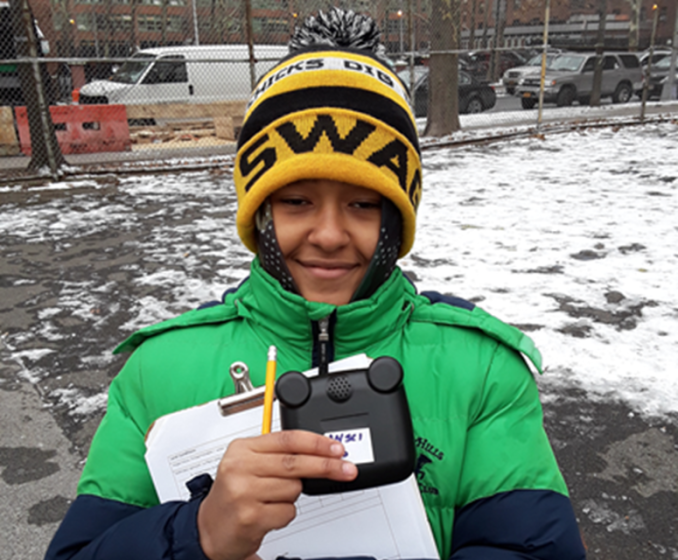
Any rational government would respond to these truths by ramping up protection for the most vulnerable populations. Instead, in early January 2026, the Trump administration announced that it would no longer consider the value of health benefits from reducing air pollutants in setting regulatory standards — most notably for fine particulate matter (PM2.5) and ozone. While monetization of health benefits may sound academic, the impacts of this decision are immediate and disastrous for Americans who like to breathe.
The federal government will no longer calculate or consider the economic benefits from lives saved, hospital visits avoided, or illnesses prevented by environmental standards that reduce these dangerous air pollutants. While these are just a smattering of the benefits associated with not breathing polluted air, they are the most easily monetized and have been used for decades in regulatory cost-benefit analysis. These monetized health benefits represent the bare minimum of truth vis-à-vis the social costs of pollution.
Some states are going even further in this war against environmental truth. Under the guise of sound science, Louisiana recently imposed unmeetable standards on community air monitoring programs—limiting the ability of communities to use this data to push for more or better pollution control enforcement. Ohio has a similar law. By contrast, industry-generated data need not meet these new standards and can be used to decline or defeat enforcement action. These laws are a thumb on the scale, designed to undermine truth.
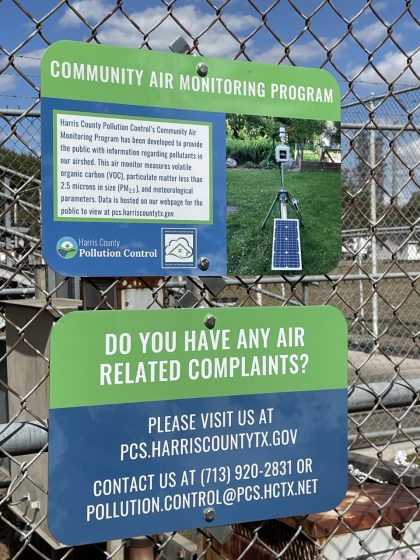
Why the attacks on environmental information? Because the truth about environmental contamination is an effective tool for social and legal advocacy. Community air monitoring fills gaps in the official (sparse) monitoring networks, identifies pollution hot spots, and documents the truth that fence-line communities face far higher exposures to toxic and hazardous pollutants than acknowledged by polluting facilities. Collecting and disseminating information documenting these environmental truths can galvanize community organizing, and sometimes producing transformative legal change.
A rational government focused on promoting the public’s welfare would embrace this environmental information. Community monitoring data can be used to prioritize enforcement efforts, reduce exposures, and as the impetus for new, more protective standards. Instead, these states and the federal government are barring regulators from using available information to protect the public.

These federal and state information-suppressing moves pose a real threat to communities on the front lines and the fence lines of the struggle for clean air. They also violate the long-standing human right to information, which includes the human right to a healthy environment and the right to environmental information.
The only good news . . . the American people strongly oppose these efforts to suppress the truth. Instead, they overwhelmingly support measures to achieve equitable access to clean air. Current political efforts at gerrymandering and voter suppression need to be understood, in part, as a fight over whether the will of the people about environmental issues (including climate change) will be heard or ignored.
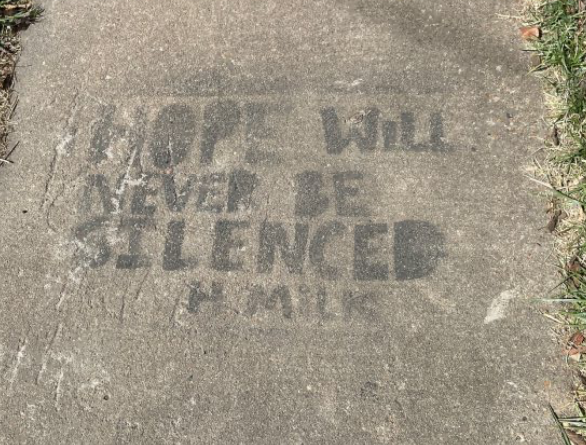
The oft-heard advice for dealing with fascism is “never surrender in advance.” That advice holds true for gathering and using environmental information as well. Those committed to truth and science and equity must continue to collect information about the impacts pollution has on our most vulnerable, and must continue to advocate for better, more protective laws. Only by resisting, persisting, and insisting will we eventually prevail.

about the writer
Erich Wolff
Erich Wolff is a researcher and educator specialized in climate adaptation with over a decade of experience researching NbS across Latin America, Europe and the Asia Pacific region. His work examines the potential of nature-based solutions to reduce the risk of disasters, improve health and support livelihoods in various contexts, with a focus in the global South. Erich is currently a postdoctoral researcher at the Department of Human Geography and Spatial Planning at Utrecht University.
Erich Wolff
In times of rising autocracy, we must continue our fight for science that is global in scope, collaborative in practice, and community-oriented in spirit.
In times of political, social, and environmental crises, our fight for a better future depends on our ability to change public dialogue and cultivate deeper relationships with society. For this reason, combatting autocracy and its interference in science demands a radical transformation of the ways in which scientists interact with society, one that is not yet fully realized in current debates about participatory or inclusive science.
If we are genuinely committed to combatting misinformation and the rise of autocratic governments, we must challenge the role of the scientist as an impartial knowledge holder and adopt a posture that is inclusive and collaborative. This posture should be unapologetically reflexive and deeply committed to connecting with people in a way that is not patronising nor tokenistic.
What collaborative research taught me
Over the last decade, my experiences working with communities in Latin America, Asia and Oceania have transformed how I understand sustainability science. My work has been dedicated to studying the technical dimensions of nature-based solutions for climate adaptation in cities, but I have increasingly been focused on “unlearning” much of what I knew about sustainability. In doing so, I had the opportunity to meaningfully connect with another group of experts: people at the frontline disproportionately feeling the impacts of climate change.
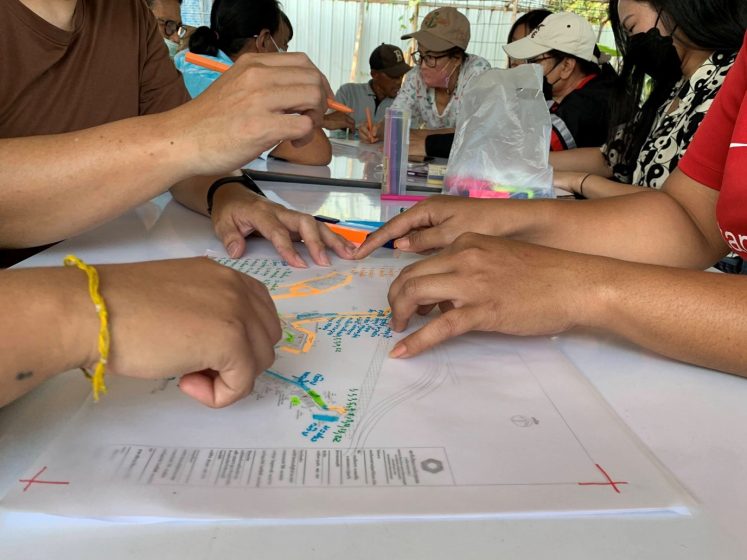
Collaborating with communities through methods grounded in trust and collaboration has taught me that science needs to be deeply embedded in the everyday life of people, reflecting their aspirations, addressing their fears, and supporting collective action [1]. Between 2018 and 2022, I experienced how this could work by coordinating a “citizen science” project to map floods in Indonesia and Fiji. This dataset was later used to inform the design of constructed wetlands and mitigate flood risk locally, with direct implications for the communities that collaborated with the very data collection. This was a significant transformation in my way of working, due to the opportunity it offered to involve people in the process of framing, examining, and intervening in a reality that mattered for them. This revealed to me not only a new way of collecting data, but also a new way of connecting with society as a scientist.
What now?
While citizen science gives us hints at what a truly new relationship between society and science could look like, I believe that most projects only provide us with a glimpse of what the potential of radically collaborative research could represent. Debates about citizen science still often emphasise scientists’ concerns with data quality and rarely account for the possibilities of making space for people to reshape science [2]. This process requires scientists to recognise and embrace new forms of collaboration motivated by a genuine intention to learn from, for, and with people.
It is important to note that this type of work is only possible with trust, fair compensation, and time, and is, therefore, inaccessible for many scientists in underfunded institutions and early-career researchers constrained by tighter budgets and growing pressure. Supporting slow and community-oriented science within academic institutions is, in this sense, also fighting against autocracy and the gradual erosion of scientific legitimacy.
In times of rising autocracy, we must continue our fight for science that is global in scope, collaborative in practice, and community-oriented in spirit. While upholding values of integrity, rigor, and ethics in science, we must also be radically open to new ways of working in which scientists can connect with people, their values, and aspirations, to support a more sustainable future.
[1] E. Wolff, B. Natakun, W. Marome, G. Chew, K. S. Tang, and P. Hamel, “Nature for the people, by the people: Negotiating values, attitudes and behaviours for implementing urban nature-based solutions in social housing,” Urban Forestry & Urban Greening, vol. 112, p. 128973, Oct. 2025, doi: 10.1016/j.ufug.2025.128973. [2] E. Wolff, “The promise of a ‘people-centred’ approach to floods: Types of participation in the global literature of citizen science and community-based flood risk reduction in the context of the Sendai Framework,” Progress in Disaster Science, vol. 10, p. 100171, Apr. 2021, doi: 10.1016/j.pdisas.2021.100171.

about the writer
Roberto Mulieri
Roberto Mulieri Co-founder and Former President (2010–2020) of the Federation of Nodes of the Argentine Landscape Network Coordinator of the Governing Council of the Exaltación de la Cruz Landscape Observatorym Co-Coordinator of the Landscape Political Management Node – LALI Director, Estudio Siempreverde – Landscape Design
Roberto Mulieri
La Autocracia Asfixiando y Paralizando el Dialogo Publico – Politico
Identificar los problemas y sus historias, analizar las posibilidades de cambio y fortalecer nuestros escenarios y nuestros discursos, debería ser un compromiso socioecologico para enfrentar a la autocracia.
El tema de la autocracia asfixiando al dialogo Público – Político se relaciona con la tendencia actual al negacionismo y a los discursos de desesperanza donde se resaltan las naturalezas egoístas de un sector de la sociedad para impedir la acción colectiva. Acción que desea encarar la crisis ambiental y por lo tanto del paisaje, sus beneficios, sus conflictos y temas como la conservación, la gestión y el ordenamiento.
Creo que tanto la falsa esperanza como la duda fatalista son paralizantes. Se relacionan, por ejemplo, con la negación del cambio climático generando la percepción de irresolubilidad y por lo tanto inacción. Tal como se intenta en nuestro país con el tema de la Ley de Glaciares.
La esperanza siempre ha sido un impulsor de cambio y de acción por un futuro mejor.
Pensar de manera crítica y fortalecer nuestros escenarios y discursos socioecológicos aportan a la construcción de esperanza y acciones transformadoras oponiéndose y superando la narrativa autocrática.
Por eso, pasar de la narrativa dominante a un discurso de cooperación, solidaridad y acción que surge del análisis critico y profundo de la realidad, posibilita cambios que se inician a pequeña escala visualizando futuros sostenibles.
Según Lorek (2023) existe un gran potencial…’’Para que las narrativas del cuidado formen parte de las trasformaciones en sistemas socioeconómicos complejos hacia la sostenibilidad’’.
Para Virtanen (2020), La sostenibilidad es la capacidad de una sociedad de crear y mantener la existencia comunitaria mediante la gestión de los recursos de una manera que asegure la supervivencia de sus miembros y del entorno que los rodea.
Interdependencia y coexistencia de un mundo humano, y más que humano, manteniendo, reparando y regenerando la compleja red que sustenta la vida. Por eso la empatía y el cuidado son fortalezas que forman parte de nuestra naturaleza compartida sobre un espacio y un destino común.
Basado en estas reflexiones creo que debemos generar discursos que identificando a las narrativas dominantes autocráticas y supuestos que la sustentan, debemos cuestionarlas y realizar eventos que las contradigan, reforzando propuestas alternativas y mas sostenibles; y proponiendo proyectos transformadores a escalas local. Dentro de estos proyectos se encuentran las economías feministas (paisaje productivo), practicas económicas que se basan en el paisaje regenerativo, que fomentan el bienestar y la distribución de excedentes dentro de la comunidad (recursos del paisaje), mientras cuidan la identidad paisajística y los bienes culturales (paisaje patrimonial).
De esta manera contribuiremos al proceso de construcción de una narrativa que fortalezca nuestros escenarios de crecimiento con justicia y equidad y también como una forma de resistir.
En un mundo con cambios tan complejos y acelerados nuestro discurso tendrá que estar en continua transformación sin necesariamente variar sus contenidos (algunas veces si y otras veces no) y no perder de vista que estamos en una sociedad global de la inmediatez.
Por lo tanto: Identificar los problemas y sus historias, analizar las posibilidades de cambio y fortalecer nuestros escenarios y nuestros discursos, debería ser un compromiso socioecologico para enfrentar a la autocracia.
(Reflexiones basadas en la lectura de artículos de Springer Nature Link)
* * *
Autocracy Suffocating and Paralyzing Public-Political Dialogue
Identifying problems and the stories behind them, analyzing the possibilities for change, and strengthening both our operational frameworks and our discourse should constitute a socio-ecological commitment aimed at confronting autocracy.
I believe that both false hope and fatalistic doubt are paralyzing. They are related, for example, to the denial of climate change, generating a perception of irresolvability and, therefore, inaction. This is what is being attempted in our country with the Glaciers Law.
Hope has always been a driving force for change and action for a better future.
Thinking critically and strengthening our socio-ecological frameworks and discourses contribute to building hope and transformative action by opposing and overcoming the autocratic narrative.
Therefore, moving from the dominant narrative to a discourse of cooperation, solidarity, and action that arises from a critical and profound analysis of reality enables changes that begin on a small scale, envisioning sustainable futures.
According to Lorek (2023), there is great potential… “for narratives of care to become part of the transformations in complex socio-economic systems toward sustainability.”
For Virtanen (2020), sustainability is the capacity of a society to create and maintain community existence by managing resources in a way that ensures the survival of its members and the environment that surrounds them. It involves the interdependence and coexistence of a human world, and more than human, maintaining, repairing, and regenerating the complex web that sustains life. Therefore, empathy and care are strengths that are part of our shared nature in a common space and destiny.
Based on these reflections, I believe we must craft discourses that identify dominant autocratic narratives—along with the assumptions underpinning them—and proceed to challenge them. We must organize events that contradict these narratives, thereby reinforcing alternative and more sustainable proposals, and put forward transformative projects at the local level. Among these projects are feminist economies (productive landscapes)—economic practices grounded in regenerative landscapes that foster well-being and the distribution of surpluses within the community (landscape resources), while simultaneously safeguarding landscape identity and cultural assets (heritage landscapes).
In this way, we will contribute to the process of constructing a narrative that strengthens our pathways toward growth—characterized by justice and equity—while also serving as a form of resistance.
In a world undergoing such complex and rapid changes, our discourse must be in a state of continuous transformation—without necessarily altering its core content (though sometimes it will, and other times it won’t)—and must never lose sight of the fact that we inhabit a global society defined by immediacy.
Therefore, identifying problems and the stories behind them, analyzing the possibilities for change, and strengthening both our operational frameworks and our discourse should constitute a socio-ecological commitment aimed at confronting autocracy.
(Reflections based on articles read via Springer Nature Link)

about the writer
Diane Pataki
Diane E. Pataki is an ecologist who studies the role of nature in urban environments, and the relationships among plants, people, the physical environment, and other species. She lives in the southwestern USA where she works on durable conservation solutions for sustainable cities, connected landscapes, and futures in which people and nature can thrive together. She serves as the Chief Scientist and Vice President for Science of the National Wildlife Federation, and is a Foundation Professor at Arizona State University.
Diane Pataki
Science needs democracy, and democracy needs scientists to speak out
In a democracy, science is for everyone, and both self-identified scientists and the public at large still have the power to demand that science serves the interests of the many.
The paper by McDonald et al. (2026) was a much-needed call to action for scholars and practitioners in sustainability to have an open dialogue about how erosions of democratic processes affect our work. Many, if not most, approaches to sustainability emphasize the need for inclusive and democratic processes that bring together communities, decision-makers, topical experts, and creative/design thinkers to find consensus solutions to complex social-ecological problems. Autocracy strips away our ability to hold these conversations, share and access data, ensure public input, and hold leaders accountable for the impacts of their decisions on communities. It also elevates special interests above the public good, often overriding public concern about nature, pollution, injustice, climate change, species extinctions, and many other consequences of putting the profit of a few above the health of many people and the ecosystems they depend on.
So, what can we do? I’m a scientist, and I commonly meet scientists who are at a loss to identify actions that can make a difference in fortifying and repairing the democratic institutions we rely on. And yet, science holds so much power in our society. If it didn’t, it wouldn’t be under such direct and sustained attack by autocratic leaders, institutions, and movements. Science, scholarship, and education all depend on free expression, free speech protections, freedom from government retaliation, and mechanisms to prevent government interference in the integrity of science. Attempts to undermine these hallmarks of democracy and civic engagement have proliferated recently in the U.S. and elsewhere. This is why it’s essential for scientists to speak publicly on why science depends on free expression, how free expression has come under threat, and what consequences we all face when research, communications, and education in sustainability and its components—conservation, environmental/climate science, ecology, geography, social and behavioral science, public health, engineering and design, the humanities, and many other fields—are the target of politically-motivated funding cuts, censorship, mass firings, government retaliation, and data suppression.
In the U.S, groups like the Union of Concerned Scientists and the American Association for the Advancement of Science offer resources and documentation about the relationship between science and democracy, steps that have been taken to undermine the integrity of science, and what we all can do to speak out and hold the line as scientists, citizens, residents, and voters. Many organizations engage the public to support democracy and civic engagement, as well as federal conservation programs (although I’m affiliated with one of these organizations, the opinions in this essay are my own and don’t represent any organization). The evidence is clear that collective action in support of science and democracy still works: several months ago, the U.S. government announced enormous planned cuts to science agencies that would have decimated sustainability-related research. But the public spoke out, and as of now, most programs are largely fully funded. There is much more to do, of course—for example, to restore the federal workforce, which lost at least 17% of its staff with STEM PhDs as of January 2026.
It’s no coincidence that the backlash against science and sustainability occurred at the very moment when both disciplines were becoming far more inclusive and democratic, opening new avenues for community-centered and community-led projects. Sustainability researchers and educators were advancing new norms and best practices, and both universities and federal agencies were expanding their requirements for ethical community and Tribal engagement. The future of science isn’t restricted to those with advanced degrees. In a democracy, science is for everyone, and both self-identified scientists and the public at large still have the power to demand that science serves the interests of the many by enabling livable cities, thriving ecosystems, clean energy, and environmental justice for all communities.

about the writer
Claude Garcia
Claude A. Garcia is Professor at the University of Applied Sciences, Bern. Trained in tropical ecology and forestry, he specializes in transdisciplinary methods and decision making, designing strategy games to help people navigate complex environmental governance across scales. He has worked across South East Asia, Central Africa, Madagascar, and Latin America. With his partners, he co-founded LEAF Inspiring Change to help decision-makers become architects of change. He plays games and would like to sail in the Greek islands.

about the writer
Patrick Waeber
Patrick O. Waeber is a free agent researcher working on environmental governance where systems start to break, from forest frontiers to wildlife trade and war affected landscapes. His research examines how institutions function under pressure, and where they fail: from CITES and transnational wildlife trafficking to socio- and ecological damage in armed conflict. He combines qualitative and mixed approaches to trace how environmental harm becomes, or fails to become, visible, actionable, and governable. Based in Sarnen, Switzerland.
Claude Garcia and Patrick Waeber
Climate advocacy and democracy advocacy are not separate causes. They are the same struggle, seen from different angles.
When Someone Is Fanning the Flames
Imagine a house on fire. People die not only because the flames spread fast, but because the alarm was cut before it could sound, because someone shouted “it’s just a drill,” because others were told the basement was the safest place, and because the doors were locked from the outside by people who kept the keys — all while those same people fanned the flames.
This is no longer just a metaphor for the climate crisis.
We have spent decades asking why people don’t act on climate change. The question assumes ignorance, denial, or competing priorities — failures of information, belief, or will. A generation of climate communication has tried to fix these failures, one at a time. But this framing misses something fundamental: some actors are not failing to act. They are actively preventing others from doing so.
In our preprint Climate Counterinsurgency: How Authoritarian Regimes Block Climate Action (Garcia & Waeber, Zenodo, 2025), we document a coordinated playbook operating across four sequential checkpoints — the same four gates any person or society must pass through to respond effectively to any threat.
First, cut the wires. Defund monitoring agencies, archive databases, fire scientists who publish inconvenient findings. Brazil’s Bolsonaro dismissed the director of the national space research institute after it reported surging deforestation. The Trump administration has retired NOAA’s climate disaster database and proposed eliminating its research office. Turkey restricts access to forestry data. The strategy works not through total suppression but through degradation: make the alarm harder to hear.
Second, shout “it’s not real!” Even when data circulate, they attack their credibility. Bolsonaro accused his own scientists of fabricating deforestation figures. Trump called climate change “the greatest con job ever perpetrated on the world” at the United Nations. The goal is not that people never hear about climate change — it is that they hesitate to believe what they hear.
Third, funnel people into the basement. Position climate action as the enemy of jobs, sovereignty, and working-class welfare. Hungary’s Orbán subsidizes a lignite plant as an act of “energy sovereignty” against Brussels elites. India’s Modi frames coal expansion as poverty alleviation. The authoritarian innovation is to make every trade-off appear zero-sum, foreclosing the very pathways that could deliver both development and sustainability.
Fourth, lock the doors and keep the keys. Russia’s foreign agent law has now inspired similar legislation in at least 20 countries. WWF Russia — decades of tiger conservation, a collaborator with the Kremlin itself — was banned in 2023. Brazil saw 26 environmental defenders killed in a single year. India arrested a young activist for sharing a protest toolkit. When all else fails, remove the people trying to respond.
What makes this a playbook rather than a coincidence is that autocrats watch each other, copy what works, and adapt it to local conditions. As Anne Applebaum documents, today’s authoritarian regimes operate as a network. Climate counterinsurgency circulates across borders as deliberately as the scientific findings it suppresses.
McDonald et al. (Nature Sustainability, 2026) document the retreating tide: academic freedom, freedom of association, and deliberative governance all peaked around 2010 and have been declining since. They frame a stark choice for sustainability scientists — keep your head down or speak up. It is the right question, and asking it publicly is itself an act of courage.
Keeping heads down keeps all doors closed, but speaking up only opens the first. We need to open all four. This requires solidarity, translation, and collective action that go well beyond the individual scientist’s voice.
Climate advocacy and democracy advocacy are not separate causes. They are the same struggle, seen from different angles.
The full argument, evidence, and case studies are in our preprint. We hope you will read it — and that you will recognize the burning house for what it is.
Garcia, C.A. & Waeber, P.O. Climate Counterinsurgency: How Authoritarian Regimes Block Climate Action. Zenodo (2025). https://zenodo.org/records/18109157
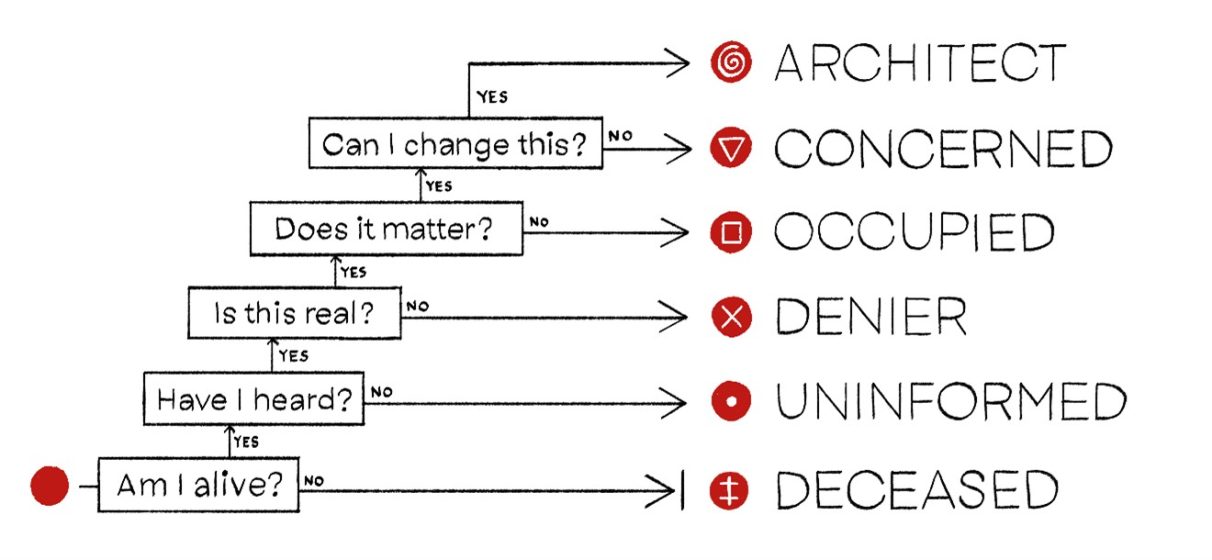
To become an architect of change, an agent must pass through four sequential gates: having heard about the problem (Information), accepting it as real (Belief), considering it important enough to act on (Values), and having the capacity to respond (Means). Failure at any gate produces a distinct outcome — uninformed, denier, occupied, concerned — but never change. At the base stands a one-way boundary: death, the absorbing state from which no gate can be reached. Authoritarian climate counterinsurgency operates by systematically blocking each gate — and when all else fails, by removing agents altogether. Speaking up opens only the information gate. We need to open all four.
Sylvain Mazas & Claude Garcia, 2025.
about the writer
Sumetee Gajjar
Sumetee Pahwa Gajjar, PhD, is a Cape-Town based climate change professional who has contributed to scientific knowledge on transformative adaptation, climate justice, urban EbA and nature-based solutions. I currently work at the science-policy-research interface of climate change, biodiversity and vulnerability reduction, in the Global South. My research interests continue to be focused on urban sustainability transitions, through collaborative governance, just innovations and climate technologies.
Sumetee Pahwa Gajjar
As we document evidence on sustainability practices, engage in dialogue with diverse groups such as artists, other scholars (such as on this roundtable), and everyday people, our endeavours at keeping the flame of inquiry and pluralism alive are even more precious and pertinent.
On other forums, I write about the need for greater financing for ecosystem-based adaptation and nature-based solutions. These are the expressions and forms of sustainability that seem most effective and sensible to me, as they aim to achieve triple, and sometimes, multiple wins: protecting people, nature, and achieving climate justice, and at times delivering economic benefits for engaged communities.
But I know very well that such sustainability initiatives only flourish when there are no wars, when governments support, or even champion, locally-led, nature-based, or nature-conscious adaptation. An autocratic government with its intent to control and censor the populace is at ideological odds with an environment of experimentation and innovation within which many sustainability-oriented ideas can mushroom, and a few of them can germinate and take hold.
In an autocratic regime, sustainability research and practice in the country get pushed to the fringe, losing much of the ground that has been achieved over the past decades, especially when there are political agendas for change or transformation being voiced or protested for. For example, we witness an award-winning climate activist being detained for six months. But how game-changing can a desire for sustainability or climate justice be, if it does not engage with governance regimes at various levels and question whether the status quo actually holds the people of a region back? Where their knowledge and diverse ways of knowing are not sufficiently taken into account in determining their futures.
As supporters and believers of sustainability practice and a sustainable world, our support for initiatives that ease and sustain a better life for the disadvantaged or the under-represented, that protect nature and respect the environment, and our efforts through scientific inquiry, scholarship, practice, or innovation, become even more critical. As we document evidence on sustainability practices, engage in dialogue with diverse groups such as artists, other scholars (such as on this roundtable), and everyday people, our endeavours at keeping the flame of inquiry and pluralism alive are even more precious and pertinent.

about the writer
Polly Moseley
Polly Moseley is a producer and PhD candidate at Liverpool John Moores University, working on applied research on social and cultural values underpinning urban ecological restoration work in North Liverpool. Her first degree was French & English Literature from Oxford, and she is interested in linguistics and place-based narratives. Highlights of her career involve intercultural exchange with Grupo Cultural AfroReggae and street art with Royal de Luxe, and land artists in Nantes. Her current projects include building the Scouse Flowerhouse movement and preparing a public campaign for the restoration of a beautiful, heritage Library building. Polly has spent a total of 22 years on kidney dialysis and has dialysed in 180+ centres. She plays fiddle and loves wild swimming.
Polly Moseley
Closing Loops ― Theorising In Numbers
Let’s not dwell on the reasons for suppression or try tactics ― it is about joining together, joining the dots, unified responses ― against racism, against autocracy and manipulation.
July 2019, Birmingham, UK: Seminar on Natural Capital Accounting
So, I found myself in an anodyne room with some serious civil servants, engineers, and those working for large landed-gentry estates. All of this accounting was being implemented ahead of any mandatory measures by local authorities and landowners seeking to monetise their income and the potential value of their land or green spaces, parks, and nature reserves. Essentially, a financialisation of the language used to describe our green spaces, public realm, estates, and nature reserves in order to justify future investment and value.
From the technical context, there was one slide that stood out to me and still stands out today, and that was when the presenter spoke about how any Natural Capital Accounting practice needs to defer to market forces. Basically, the approach should be market-led.
So, this made no sense to me whatsoever. In fact, it undermined the whole impetus behind and rationale for nature restoration. Britain has both an amazing record in the decline and a shameful record in the depletion of nature. If we are to turn around biodiversity loss, then surely, we need to cut against the markets with innovation, not follow the markets, which are responsible for this nature depletion. Doing this also gives the accountants more power and those working on the ground less power, which is perhaps why the Natural Capital lobby is integrated with US and UK accounting bodies.
Michael McIntyre wrote in his book ‘The Moth Snowstorm’,
…the science of ecosystem services quickly grew into a discipline of its own…Yet while a new defense is being offered ― as we examine it, we realise that it too is deeply crucially, fatally flawed…
Afterwards, I called into Birmingham City Library and a small group of the trainers, all white men, were discussing where the next lot of money from government for their consultancy work was going to come from ― a closed loop, consultants being paid to train civil servants into their way of making accounting spreadsheets, and valuing land in a cultural sense from how far people drive to come and how much they pay for a coffee.
23rd-25th February 2026, Dirty Business airs on Channel 4
The UK’s privatised water industry is called out as “Britain’s largest organised crime syndicate”. This docudrama goes into the detail of how the Environment Agency was paid off by water companies to stop monitoring the discharge of raw sewage into our rivers and coastlines: the human and ecological cost and the vast profits made by investment firms, such as the Australian Macquarie. Having been hospitalised twice in 1997 and 2016 with Ecoli after 2 separate holidays in Cornwall with a lot of sea swimming, this drama held horrific resonances with my own life and health. Again, the policy implementation was creating a closed loop on the premise of lack of funds, when effectively the funds were being leeched into shareholders’ bottomless pockets.
Water, in many ways, is the connecting force of our lives – it is a big part of our bodies, and our daily need to stay alive. Literally watching how our waterways have been filled with shit when handed over to “the market” is maddening. The connection between our health, our waterways, and our future is clear to all ― the financial rationale for destroying life in our waterways and our own lives is total nonsense. Yet, the man who oversaw this work was still employed by Welsh Water when the films came out. And the men who oversaw the failed PFI deal for Liverpool Hospital are still in big jobs.
CONFLICTING POLICIES – WHICH IS WORTH MORE?
18th May, 2024, Kendal Museum
Karen Lloyd opened this day on nature recovery by talking about research charting the drastically harmful effects of LED lights on pollinators. In my local park, lighting and CCTV are the main actions which our local Councillor fights for, and they are going up with 5G posts in all of the parks where we have put in wildflowers. So, which strategy is more important ― Women’s Safety / Policing or Pollinator Strategy ― or do LED lights need to be on sensors like in the Netherlands?
When our Metro Mayor stands up for ReWilding one day and stands up for building a vast number of houses the next ― who is joining the dots between where green space needs to be protected and when it could be built on? If it comes down to the maths, it will be built on. But everyone likes a strategy which looks lovely, filled with pictures of wildlife and breathtaking views and flowers, at least that is what the powerful Comms departments say.
March 2026, British Ecological Society Newsletter
This month’s e-newsletter leads to the fact that the UK Government is suppressing reports about food insecurity hitting hard in 2030 unless urgent action is taken. The Times has published a report ― both the Times and the BES not being perceived as radical organisations ― the scientific evidence-based, for food insecurity, which, like water, is critical to all human wellbeing and ecosystems. The lead headline article suggests that the Government is underestimating public opinion, saying, “Survey data has shown that there is more appetite for climate and nature action from the public than governments’ acknowledge, with 80–89% of the people around the world wanting their governments to be doing more.”
One thing is doing more, the next is a complete overhaul of existing systems, of education, of the way in which our institutions are managed, which is essentially in militaristic structures put in place after the C20th World Wars. Structures that send us around in circles of demolition and destruction and rebuilding rather than transformation.
NO MORE TIME FOR TOKENISM OR FOR LATE-IN-LIFE REDEMPTION
This last Christmas, Richard and I were sent a book called “The Struggle for Space: The Greening of New York City, 1970-1984”. It’s an impressive record of a groundswell in community gardening across vacant plots in Manhattan and New York City during a period of market failure. The feeling within the book is one of impending threats to these spaces. I like the multitude of voices in the book and the logging of the creative approaches to gardening the spaces. August Hecksher, as a much-lauded philanthropist for parks, writes,
“The trouble with open space is that in order for it to be useful open space, it has to be in the right place in relationship to where people live, and it has to serve real needs. Empty pace is not very useful to anybody expect that it may save our lives in the end ― save us from asphyxiation.”
August made its money from mining and real estate. Rather like the slave traders’ beautiful estates, this is not mentioned. So many people we read and respect without question, including Schumacher, Lovelock, and others, have spent their working lives working for markets and harming nature, and then write and advocate for good at the end of their lives. This generation has no time for that. The Clinton Community Garden, with 100 volunteers, is beautiful and rightly held up for its work, but Clinton sold out to market forces very early on. Why do we constantly hold up and respect those who are at the top of the class hierarchy rather than those who do the work?
When important decisions are being made, who is in the room? Whose voice needs to be foregrounded? Where does innovation and change come from?
27th-28th June 2025, British Library, London,
Gardens and Empires Conference
And the digitisation of Kew Gardens’ records made this conference interesting in terms of exposing racism within the institution and extractive colonial practices. There were some presentations of research that definitely held up extravagant and cruel practices as impressive, and others that were more challenging. The final panel comprised activists, with little ownership of future actions by institutions responsible for the funding and the conference itself. It was a start, yet the research-heavy emphasis and choice of papers by people who were running the conference, to include those working on the conference, again implied a narrow focus and closed loop. Designing in autocracy to gardens from the empire period ― designing in lawns and showy displays is something which people still aspire to without challenging how accessible these “beautiful” places were and are, both to nature and to most people. Beauty can come from different ways of managing in abundance, plants and people, rather than stripping it out of our cities.
ARE CHECKS AND BALANCES ENOUGH?
The latest publication on checks on natural capital accounting is convoluted, to say the least. New members of staff to manage these processes rather than Gardeners on the ground ― which will have more impact? Mariyn Waring exposes how Care is built out of our GDP, and this means looking into new ways of accounting which are much broader in social and cultural values than those considered at present.
Having started a doctorate in how the natural capital approach relates to the social, cultural, and environmental values applied to green space locally in North Liverpool, I delved deeper to find some economic models I can subscribe to. The work of Elinor Ostrom truly made sense ― a distributive model of investing in the people closest to the land over time for restoration: so this has underpinned the work of Scouse Flowerhouse Ltd ― a membership society and co-operative now with 190 members in Liverpool, with each wildflower site connected to local people, whether in groups or as residents who care.
Those spaces which have been the best for us are ones with a long burn ― people have wanted something to happen over years, and the catalyst to the wildflower change has often lain outside of the realm of nature ― a bike track, an old forgotten cemetery, a depot which used to house a botanical collection. Honouring what has come before and signaling what can come next, whilst we wildflower these sites, has given our events additional meaning.
LOCALISM WITH TOP-DOWN MODELLING: NOT AGAIN!!
The few streets where I live have been granted £20m over 10 years from a new government fund called Pride in Place. The starting point for this is to employ a voluntary Chair before the Committee and before the programme starts, so not a great way to avoid autocracy and corruption. The skills required to lead such a programme involve humility, conflict resolution, strategic vision, and the people working hard with those skills in our community are not those who can afford the time and energy to do such a role.
Every decision we make in relation to our locality, our mode of transport, where we buy our food and furniture, our modelling of behaviour has an impact on nature restoration, on our young people, where our energy lies as a species, and on other species.
After a reading I organised in the school down the road, a bustling group of young women crowded around me and our local councillor ― wanting to become politicians.
We don’t have to look far to find the pointers for hope and the questions that need asking. Critical thinking can be constructive and should inform research, which should inform policy. Research and consultancy should not be conflated, so independent research requires more funding, and the funding behind research should always be cited up front.
Porosity: ideas which grow between the cracks and flip over the norms rather than entrench the problematic economic underpinning of our social policies and investments ― this is what we should be looking for and uniting our energies behind. And the hidden stories within our neighbourhoods are global, fascinating, and abundant, like the bee orchids flourishing after 2 years of restoring my modest front garden.
So, who is in the room? Who is in the field? Can the room be moved to the field? Can voices not in the room be elevated to be heard? Who is doing the active listening?
Let’s not dwell on the reasons for suppression or try tactics ― it is about joining together, joining the dots, unified responses ― against racism, against autocracy and manipulation.
When resources are few and far between, innovation, humanity, and originality surface. But resources are not few; they have been deliberately displaced, and we owe it to our communities and younger counterparts to be bold in calling this out and to make our public realm and services the best they can be by valuing the worker bees.
about the writer
David Simon
David Simon is Professor of Development Geography at Royal Holloway, University of London and until December 2019 was also Director of Mistra Urban Futures, an international research centre on sustainable cities based at Chalmers University of Technology, Gothenburg, Sweden.
David Simon
Increasing activist scholarship will gain importance, as will building alliances with other actors and cultivation of alternative non-traditional funding sources. One potentially fruitful form of progress could be more widespread engagement with citizen scientists as full research partners.
There can be little doubt that we are living in turbulent and troubled times, in which many – perhaps most – internationally accepted rules, norms and practices of the post-Cold War order, rather like that order itself, are under threat. It is therefore no surprise that science and sustainability research are feeling the heat. The rise of authoritarianism and increasing popularity of autocratic political leaders indeed form a key element of the crisis. However, I judge that to be as much symptomatic of the wider neo-populist Zeitgeist as the primary cause since many such leaders arise and feed off the mood, in turn stoking discontent in order to increase their appeal.
Delving rather more deeply to discern the underlying causes is a task far beyond scope here. However, there appear to have been deep currents of discontent and frustration by considerable groups of people excluded – or who feel excluded – from the fruits of scientific research and the deliberative weighing of evidence which that entails. Sometimes these are poor, marginalised groups but at other times and elsewhere, they may be wealthy and are driven by perceived self-interest in pursuing such agendas.
One such litmus test moment in the UK came over a decade ago, when a well-educated and highly articulate government minister, presented with mounting evidence that the policy he was articulating would be highly counterproductive, notoriously exclaimed in frustration that ‘We are sick of experts!’ The considerable shock and outrage this engendered were, nevertheless, outweighed by wide populist expressions of support. Small wonder, then, that over the following decade, the former government was often accused of abandoning the formulation of evidence-based policy in favour of the search for policy-based evidence! This is increasingly true in many contexts internationally.
That notwithstanding, the second Trump presidency has already proved globally disastrous in terms of cancelling climate-related research, much vital official development assistance addressing the effects of climate change in poor countries and communities, gutting key federal agencies and censoring academic syllabi. Even in many countries where climate research is not explicitly proscribed or restricted, austerity-driven funding cuts have had a pernicious effect by undermining the plurality of projects and perspectives on which rigorous scientific debate and evidence-weighing depend. Instead, ‘economic necessity’ has led to replacement of many smaller grants by fewer ever-larger grants that are perceived as cheaper and easier to administer and somehow more efficient. This is giving rise to a handful of large ‘centres of excellence’ and loss of heretodoxies in favour of new orthodoxies.
Ultimately, however, this will also impoverish the very science it claims to propel to global leadership. The COVID pandemic and successive geopolitical and economic shocks, such as currently in the Middle East, are further fuelling (neo-)populism and making any rapid turnaround in government-sourced scientific research funding very unlikely. In this context, concerned researchers must become more vocal in addressing the wicked societal challenges, both in research publications and venturing beyond the academy to address diverse publics directly by ‘translating’ their research findings into readily accessible terms for the respective audiences. Increasing activist scholarship will gain importance, as will building alliances with other actors and cultivation of alternative non-traditional funding sources. One potentially fruitful form of progress could be more widespread engagement with citizen scientists as full research partners, thereby harnessing more diverse knowledges, building capacity in local communities, and empowering and possibly assisting citizen action.
about the writer
Paul Downton
Artist, writer, ‘ecocity pioneer’. A former architect with a PhD in environmental studies, Paul is distressed by how the powerful idea of ecological cities has been perverted, citing ’Neom’ as a prime example. Still inspired by his deceased life-partner Chérie Hoyle (1946-2024), Paul is continuing his graphic novel / epic poem / art project called ’The Quest for Wild Cities’ that he promised Chérie he’d finish along with his 80% complete ‘Fractal Handbook for Urban Evolutionaries’!
Paul Downton
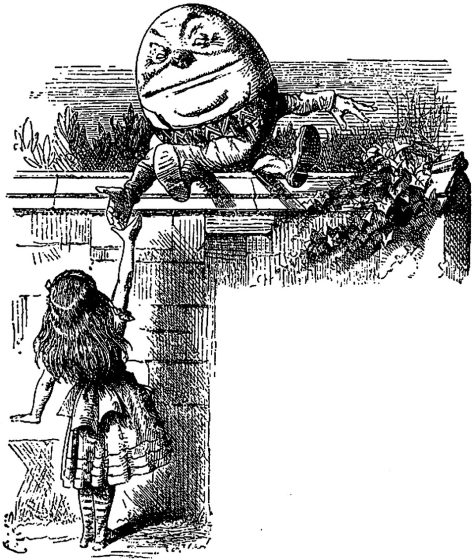
Bully for you, Humpty!
The shit-show that is modern politics employs every trick in the bullies’ book, and the only way to counter bullying is to refuse to be bullied.
I have difficulty discerning any fundamental difference between autocrats and bullies other than autocrats are given more social license and money to pursue their goal of absolute power over everyone else.
Any means of exerting power, especially by fear, seems to be acceptable. The social license to exert absolute power or control, such as it is, can be bought. I don’t think a long essay on the power of wealth is needed ― it appears to be a given in any society. Money may not buy you love, but it can coerce something similar as a distorted medium of exchange between lovers and loved ones of almost any persuasion. It can certainly buy you control over those who don’t have it.
That control includes the capacity to shape belief and define ownership. The tools available are many. History has demonstrated and continues to demonstrate how the first target of autocratic regimes is to gain control of the means of providing information to the masses and thence to define what is true and what is “fake news”. This has rarely been done in a more crass and absolute way than we are seeing in the contemporary political environment of the so-called “United” States of America, with the difference from previous eras being the increasing sophistication and reach of electronic media.
This all comes back to how we use and understand language; that truth is the first casualty of war is a truism with a lot of truth in it.
George Orwell is famous for his portrayal of a total surveillance society in which every move of every individual is observed and recorded. This is the ideal state of society for any autocratic regime (knowledge is power). Orwell imagined that level of surveillance could only be achieved by the dictates of centralised autocratic government but as I recall one of the first instances of cameras surveiling public streets in the name of law and order was when the citizens of an English town voted to employ closed-circuit television ― it was adopted by choice, rather than imposed by a remote central authority (I trust my memory on this factoid, but can’t pin down a reference on the internet…).
Surveillance technology has advanced in leaps and bounds and become a familiar, expected, and ubiquitous part of daily life, but before the technology advanced to make cameras cheap and readily available, such universal surveillance could only be achieved by central government. Orwell was correct about a future of universal mass surveillance, but didn’t imagine that its imposition would be via a mass movement of public choice.
A much more important theme of Orwell’s “1984” was to do with the manipulation of language and memory as a vital part of an autocratic state. Think of it as ‘dumbing down’ as it involves reduction of vocabulary, change and distortion in the meaning of words ― and constant revisionism of historical understanding.
The shit-show that is modern politics employs every trick in the bullies’ book, and the only way to counter bullying is to refuse to be bullied. Easily said, but I can’t see any other viable strategy, and the first step is to take control of the language we use in every aspect of life ― work, education, research, entertainment, art ― and politics. And to remember that autocracy is inherently about a lack of trust, whereas science and democracy require trust to function.
The great logician, mathematician, and weaver of words, Charles Lutwidge Dodgson, illustrated the essence of these argumentations through the mouth of a very large egg:
“When I use a word,” Humpty Dumpty said, in a rather scornful tone, “t means just what I choose it to mean, neither more nor less.”
“The question is,” said Alice, “whether you can make words mean so many different things.”
“The question is,” said Humpty Dumpty, “which is to be master ― that’s all.”

about the writer
Cecilia Herzog
Cecilia Polacow Herzog is an urban landscape planner, retired professor at the Pontifical Catholic University of Rio de Janeiro. She is an activist, being one of the pioneers to advocate to apply science into real urban planning, projects, and interventions to increase biodiversity and ecosystem services in Brazilian cities.
Cecilia Herzog
It’s time for scientists to take serious consideration and adopt strategic actions to work in symbiosis with all types of bottom-up movements, in key biomes of the planet, and other environments, with emphasis on where most people live: in cities.
Science, people, and arts: an urgent alliance
The current global geopolitical reality and the future trend of rising autocracies pose a growing threat to the maintenance of life on this wonderful planet, our common home. Science is being discredited and defunded by powerful governments, supported by the five Ps: Plutocrats, Petrostates, Propaganda, Pros (professionals hired to spread misinformation and disinformation), and powerful segments of Press (influential media owned by plutocrats, including social media), as Michael E. Mann and Peter J. Hotez dig deep in their recent book “Science under Siege.”
Even under ‘democratic’ regimes, such as in Brazil, we have witnessed the disregard of scientific knowledge that highlights the critical need to protect and regenerate the Amazon biome, with the development of destructive mega-projects in its main rivers and in the Amazon river delta. Belo Monte hydropower plant on the Xingu River, completed in 2016, is one of them. Dilma Roussef, from Partido dos Trabalhadores (Labor Party – left-leaning party, supported by Lula da Silva), gave the green light to advance with the project, despite clear scientific evidence and mobilization from civil society. The result: the displacement of indigenous and traditional communities who had lived in harmony with nature for generations, and a severe impact on aquatic and terrestrial ecosystems. In this case, the ‘market’ won over science and people, disfiguring one of the Amazon’s most vital rivers.
We are losing the communication battle. Data alone is not enough to mobilize people for the urgent challenges that are threatening their lives and their descendants’, maybe they are not even aware of that, they are misinformed and disinformed… I believe that science needs to embrace innovative ways to seduce people, engaging with bottom-up movements that are transforming hearts and minds, reshaping imaginaries and behaviors on the ground.
An inspiring act of resistance
Earlier this year, the Indigenous peoples of the Tapajós River valley, where President Lula da Silva had authorized the privatization of fluvial transport routes through Presidential Order 12.600/25, rose in defense of their sacred river. The dredging plan for the river, intended to expand soybean exports, threatens the ecological health of the basin and the land and cultural fabric of the original peoples.
For these communities, the river is sacred. It is home to the “Big Snake,” the guardian of all life. People and river are inseparable; children grow up in communion with its waters and all forms of life, which are an extension of their own bodies.
Fourteen Indigenous groups, including the Munduruku, Apiaká, Arapiun, Borari, Tapajó, and Tupinambá, organized an extraordinary act of resistance. They occupied a Cargill (a powerful private American company) port, built over an ancestral cemetery, for 33 days. Major national media mostly ignored their action, another piece of evidence that the narratives are controlled by the power of the “market”. Yet, in social media, activists and allied civic organizations amplified their voices, generating national solidarity. As a result, President Lula revoked the order, at least for now. The struggle continues, but this victory shows that collective action still matters.
Science and bottom-up movements: a necessary alliance
Perhaps it’s time for scientists to take serious consideration and adopt strategic actions to work in symbiosis with all types of bottom-up movements, in key biomes of the planet, and other environments, with emphasis on where most people live: in cities. They could adopt more passion and emotion in their narratives, rising all people’s biophilic deep feelings.
There is a myriad of place-based and virtual groups that are working to protect, conserve, and/or regenerate life and water bodies, as well as connect people to nature in all places: forests, oceans, rural, and urban. The aim is the same: to change the paradigm, leave inside the planetary boundaries with justice and dignity for all.
Maybe the way to face the challenges of autocratic or “democratic” regimes that are of service to the social-ecological predatory neoliberal economic system is to join knowledge, energy, and passion. Science, people, and arts together, an urgent alliance that could build new life-prone imaginaries and promote actions for all scales’ sustainability, based on love, empathy, and compassion for all living beings and landscapes. In my view, this could be a good bet to confront the intertwined crises of democracy, ecology, and meaning.
https://sumauma.com/retomar-o-rio-o-levante-indigena-contra-a-venda-do-tapajos/

about the writer
Pau G. Aleikum
Pau Garcia is a media designer and founder of Domestic Data Streamers. Since 2013, the Barcelona-based studio has researched and produced immersive “info-experiences” and GEN-AI projects for institutions such as the United Nations, Barcelona City Hall, and Citizen Lab over 45 countries. Garcia is chair of the Master in Data in Design at ELISAVA University.
Pau Aleikum
The Means of Knowing
I believe that the most urgent question isn’t how to protect science from autocracy. It’s how to make knowing something that belongs to everyone, everywhere, all the time, so thoroughly woven into civic life that it becomes, practically speaking, impossible to suppress.
The question posed: what happens when autocracy strangles science, assumes something I want to push on a little. It assumes science was breathing freely before.
I run a studio in Barcelona that sits at the intersection of data, design, and civic life. We build installations, tools, and experiences that try to make complex information feel like it belongs to everyone, not just to the people who already know how to read a complex scatter plot. And from that vantage point, the problem isn’t only that authoritarian regimes are defunding climate research or censoring environmental data. It’s that the systems we built to produce and circulate knowledge were already dangerously over-centralised. I don’t think autocracy creates that fragility; I think it exploits it.
To have an exmaple; A government that wants to suppress inconvenient science only needs to cut a few budgets, fire a few directors, and intimidate a few publishers. That’s possible because knowledge production still flows through a small number of institutions, journals, and funding bodies that act as bottlenecks that were designed for quality control but now are being used as chokepoints. The architecture of how we know things has a single-point-of-failure problem.
The most useful thing we can do right now isn’t just defend existing institutions, though that matters enormously. It’s to distribute the capacity to make knowledge in the first place. Build redundancy into the system. Make it harder to shut down. This is where I think sustainability practitioners, creative technologists, designers, educators, and anyone who works with public knowledge have real agency.
What does that look like in practice? A few things I’ve seen work, or at least point in the right direction:
Give people instruments, not just conclusions. There’s a difference between telling a community that their air quality is bad and giving them the tools to measure it themselves. The first creates dependence on the messenger. The second creates a thousand messengers. We’ve seen this with citizen science projects, open-source environmental monitoring, and community-driven data collection. When people can generate their own evidence, censorship becomes really difficult to create.
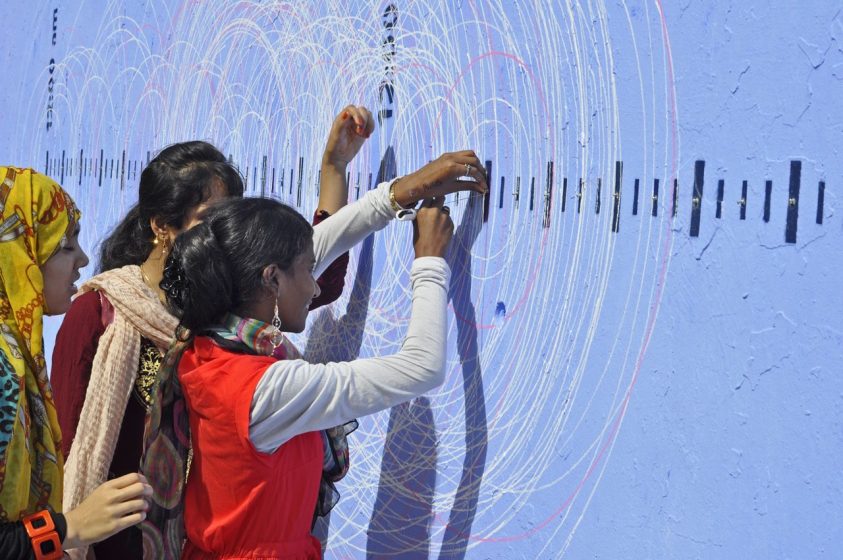
Use technology to watch the watchers. The same computer vision tools that governments deploy for surveillance can be turned around. Projects that use publicly available parliament livestreams to track politician disengagement, or browser plugins that help readers identify rhetorical manipulation in news articles, are small acts of democratic hygiene, built with the same technologies that threaten democracy. The tool itself can be presented as morally neutral, but the direction of the gaze is everything.
Design for accommodation, not just assimilation. There’s a concept in learning theory: assimilation is when new information fits neatly into what you already believe. Accommodation is when it forces you to rearrange the furniture in your brain. Autocracies thrive on assimilation and keep people comfortable in their existing mental models, and reinforce them. Migrants are bad, anyone who thinks differently from you is a traitor, and so on… The most powerful sustainability work I’ve encountered does the opposite. It creates spaces, physical, digital, conversational, where people encounter information that doesn’t fit, and gives them enough safety and curiosity to sit with the discomfort. Cultural institutions, public squares, and even well-designed websites can do this. But only if they’re built as open systems where the audience completes the meaning, rather than consuming a predetermined message.
None of these ideas is a substitute for political resistance, legal protections for scientists, or international pressure on authoritarian regimes. Those fights are still essential. But they’re also slow, and they can be lost. What can’t be easily lost is a population that knows how to ask its own questions. The mycorrhizal fungus network under the forest floor doesn’t care which tree gets cut down. It keeps moving nutrients through the soil regardless. That’s the kind of knowledge infrastructure we need, not a few tall trees, but a root system so distributed, so entangled with everyday life, that no single act of political violence can kill it.
I believe that the most urgent question isn’t how to protect science from autocracy. It’s how to make knowing something that belongs to everyone, everywhere, all the time, so thoroughly woven into civic life that it becomes, practically speaking, impossible to suppress.

about the writer
Anne Maassen
Anne Maassen is an urban geographer and sustainability researcher with a focus on how cities transform and what makes change stick. At the WRI Ross Center for Sustainable Cities, she works across research, knowledge and learning for the global cities program, helping to shape how urban sustainability research is produced and applied. Her research centers on comparative case studies from cities worldwide, examining the conditions that enable equitable and resilient urban change.

about the writer
Tom Black
Tom is a public opinion researcher and strategist with twenty years’ experience spanning politics, media, and behavior change campaigns. He has led research projects in more than twenty countries and is based in Washington, DC.
Anne Maassen and Tom Black
Same Squeeze, Different Answers
Rather than defending science from above, it is possible to connect sustainability to what people already value and need today.
A deep shift has taken place since 2015, when we ― two Western Europeans ― started calling this city, Washington DC, our new home. Until recently, our work in sustainability and public opinion research was buoyed by a growing narrative consensus and stable (if inadequate) funding flows for science, sustainability, and human flourishing. Now, the sector is contracting ― budgets cut, a regional economy shaken by layoffs, mis- and disinformation rampant. Below the surface, something deeper has shifted too: the horizon has shrunk.
Sustainability ― meeting current needs without compromising future generations’ ability to meet theirs ― requires the capacity to imagine the world they will inherit. But when immediate pressures take over, a field built on the long, collective view risks losing its footing. We believe the answer lies not in defending institutions and asserting scientific authority. Instead, the starting point is understanding that contemporary societal currents ― an escalation of anti-science, anti-climate, anti-democratic rhetoric and policymaking ― are not distinct trends but rooted in a single condition: a citizenry that shares a perception of economic precarity, ecological disruption, and unaccountable political elites.
We believe that autocracy and sustainability can usefully be understood as alternative responses to a shared underlying anxiety among citizens. When people experience the world as chaotic and see traditional responses as ineffective, they may reach for radical solutions. This is illustrated in the desire for stronger political authority in South Africa, where the 2025 Afrobarometer shows almost half of respondents are dissatisfied with their democratic institutions and approve of military rule. Contrast this with the rise of a growth-critical (“degrowth”) movement in environmental politics, calling for a democratically planned downscaling of economic activity to reduce environmental impact and economic inequality. Both are reaching for the same thing: stability, restoration, a world that feels less out of control.
But autocracy and sustainability are not neat opposites. For one, the evidence that a democratic political system promotes a decrease in CO2 emissions is weak ― while democracies tend to adopt climate policies, laws, and regulations at a higher rate than autocracies, climate performance is more strongly influenced by other factors, including economic growth, energy mix, corruption, and income distribution. The idea of climate autocracy and calls for enlightened despots further underscore the muddled relationship and draw attention to the real question: what makes people more likely to choose collective responses over authoritarian ones?
Two pieces of recent communications research point toward an answer. A large-scale study testing common climate messages among American audiences found considerable common ground across party political lines when messages were framed in terms of one’s relationships and tradition ― the nation (patriotism), family, and religious or other community; and when connected to preserving traditional American ways of life. Separately, Gallup data also clearly show consensus across party lines for foreign policies that prioritize national self-interest (e.g., terrorism, nuclear weapons, energy security), while the consensus breaks down as foreign policy becomes framed in broader mutually beneficial, reciprocal terms (e.g., multilateralism, poverty and disease reduction, human rights).
The evidence suggests a way forward. Rather than defending science from above, it is possible to connect sustainability to what people already value and need today. Across partisan lines, people want safe neighborhoods, stable energy costs, clean air, and a future in which their children can flourish. These are sustainability goals, whether or not they are named as such. The risk of autocracy is precisely that it promises to deliver these things by concentrating power, but in fact produces neither stability nor wellbeing. The more durable response distributes agency rather than concentrating it; in communities that shape their own energy future, neighborhoods that design their own green spaces, cities that plan for their own resilience. Built from the ground up, these approaches don’t ask people to adopt a worldview but deliver one. In doing so, they may quietly restore our collective capacity to plan beyond the immediate horizon.

about the writer
PK Das
P.K. Das is popularly known as an Architect-Activist. With an extremely strong emphasis on participatory planning, he hopes to integrate architecture and democracy to bring about desired social changes in the country.
PK Das
People’s liberation and solidarity movements for social and environmental justice, and the rights and city, have the potential to cut across these multiple barriers, challenge the ecology of segregation, and enable the unification of the city, not uniformity as perpetuated by autocratic regimes.
Down The Rising Autocracy
We have come-together to discuss, being aware and deeply concerned, the phenomenon of the rising autocracy inevitably entwined with fascist trends around the globe and the severity of its brutal consequences on people and the planet. While continuing to critically analyse its history, now on this table we must dwell on the question that is most challenging of all—what now? And discuss ways of intervention to break the prevailing order and the business-as-usual approach that is increasingly normalised―the ecology of segregation that is rigid, monolithic, exclusionary, hierarchical, divisive, illiberal, and caring little for the natural ecology and the environment. This is to bring about much-needed change in the ongoing social, political, environmental, and spatial ethos and relationships.
First of all, one effective democratic way to do this is to influence and strengthen public knowledge and inform and stir movements for equality and justice around social, political, and environmental rights and the city. The city must continue to be considered as a space for the achievement of freedom and liberation of all against the forces of intimidation and control by a few, because the question of ensuring people’s rights is entwined with the happenings in the city; it is because rights and rights-based struggles matter, they show us the path to a better, more livable, and just and sustainable city for all.
Also, our action plans must mend ways and means that challenge the power structures that are increasingly centralized, thus challenging the idea of centralism―of amenities, markets, civic services, parks, public spaces, natural areas, and most importantly, of political power. Creating multiple unbarricaded linear structures of inter-connected places and people within the existing divided and disparately fragmented built form of the city would be an important intervention, thereby enabling the formation of an engaging and participatory democratic order beyond boundaries of divide to bring about the much-needed change towards sustainability.
Also, the institutions of exchange must now be reclaimed to open and democratize them―cinema clubs, cultural complexes, study circles, libraries, discussion groups to sustain movements and public life―now weakened or folded up or occupied by agents of the autocratic regimes, and due to the severity of the repressive measures by the ruling dispensation. This is a way to revive with greater strength the opportunity for people to come together and engage, connect across interests and ideologies, and form movements and collectives. The questions of rights and justice, the natural areas conservation and restoration that have been hugely destroyed in the name of development in the presence of multi-crore gleaming infrastructure projects, must form the basis of our struggles too.
Second, our intervention objective must be to reclaim the multiple layers of relationships in cities―between people, collectively between people and nature, between people and the built environment―that are intertwined and impact one another but have been severed and strained both by autocratic governments and the neo-liberal economic order. City-making or the built environment, what we call development, is separated from nature by design as governments and private capital ignore the damaging and unsustainable consequences of one on the other. Their attempts to overcome the forces of nature through counter-productive capital-intensive engineering and technological interventions end in miserable failure, even as the climate crisis looms larger by the year. This is the ecology of segregation, which damages the nature and people in cities.
Also, a paradigm shift from our individual and collective mind-set would be necessary, otherwise formed and nurtured by the increasingly dominant neo-liberal and supporting majoritarianism-based social, cultural, and political order that is reflected in exclusivism, cultural uniformity, and violence.
Also, interventions through democratic rights movements are important to address the growing cynicism, complacency, and silence amongst large sections of the population, who are absorbed in the daily chores and resigned to prevailing oppressive conditions promoted by the neo-liberal globalisation, privatisation, and free-market driven economy, thereby perpetuating a false sense of freedom, individualism, and self-sufficiency.
Dialogues now confined to rooms must be moved to the streets to revive wider public meetings and protests. Each movement must connect with other democratic rights struggles for building solidarity across sectoral interests that are otherwise disparate. We must popularise and democratize all forms of scientific knowledge.
Thirdly, breaking the order means destroying or disrupting this ecology of segregation and the prevailing spatial order in a purposeful and organised manner, to evolve a new ecology of cities. There are new challenges from the climate crisis to severed relationships, which cannot be addressed by planning and making cities in the conventional manner with ideas and principles that were set in stone more than half a century ago or aggressively pursued with the neo-liberalisation objectives.
Now, urban planning or planning cities and city spaces must keep pace with the new challenges and reflect the new ecology of cities―cities that are open beyond the boundaries of division, where relationships between people and collectively with nature are reclaimed, and in turn contribute to its formation. Both these approaches, breaking the order and creating a new ecology of cities, must be reflected in the spatial order we make that is sustainable.
The lethal combination of hierarchical order with centralised power structure re-enforces exclusionary and discriminatory measures that further barricade, fragment, and break down the city landscape into conflicting territories. A hierarchical order influences and regulates people’s access to spaces in the city.
As cities get divided, places and people are categorised and classified, and their access to resources and opportunities are regulated based on class, gender, and majority and minority community basis. People’s liberation and solidarity movements for social and environmental justice, and the rights and city, have the potential to cut across these multiple barriers, challenge the ecology of segregation, and enable the unification of the city, not uniformity as perpetuated by autocratic regimes.
about the writer
Thomas Elmqvist
Thomas Elmqvist is a professor in Natural Resource Management at Stockholm University and Theme Leader at the Stockholm Resilience Center. His research is on ecosystem services, land use change, natural disturbances and components of resilience including the role of social institutions.
Thomas Elmqvist
The crisis is real. But so is the opportunity to build a knowledge system worthy of the challenges we face.
Science Under Siege: Defending Knowledge in an Age of Rising Autocracy
The science of sustainability does not operate in a vacuum — it depends on open inquiry, transparent data, institutional trust, and the freedom to speak inconvenient truths to power. All of these are under assault and suppression. The mechanisms of suppression are varied but recognizable. Authoritarian governments defund environmental agencies and dismiss their scientists, as when all authors working on the flagship US climate report were dismissed in 2025. They censor inconvenient findings, intimidate researchers, and reframe environmental protection as an obstacle to national development or sovereignty. They dissolve the multilateral agreements that sustainability science helped build, withdrawing from the shared frameworks that allow nations to act in concert on planetary problems. They weaponize disinformation to corrode public trust in evidence itself. For sustainability researchers, this is more than a political inconvenience — it strikes at the foundational assumptions of our field: that knowledge can be produced, shared, and translated into collective action.
Yet, we live in a time when the challenge is not only external. Even as autocracy presses from outside, sustainability science is grappling with deep tensions from within. Academia has historically played a central role in enabling societal progress, and today, faced with a polycrisis of ecological breakdown, political polarisation, and widening inequality, societies once again turn to it for viable solutions. In response, the academic system itself has become a site of transformation — a space where existing structures and norms are increasingly contested, and where innovative practices are struggling to take root.
Particularly prominent is the growth of participatory forms of research: action research, transformative inquiry, transdisciplinary collaboration, and knowledge co-production with communities, practitioners, and policymakers. These approaches enact different visions of what the relationship between science and society can and should be. They are often explicitly normative, oriented not just toward understanding the world but toward changing it. And precisely because of this, they sit uneasily within academic institutions whose rules, evaluation systems, and governance arrangements were built for a different kind of science — one that is individual rather than collaborative, detached rather than engaged, and measured by publication metrics rather than real-world impact.
This internal friction deserves honest reflection. How can researchers committed to co-production and societal change navigate institutions that were not designed for such work? How do we evaluate and reward the slow, iterative, relationship-building labour that transformative research requires? These are not merely procedural questions. They go to the heart of what kind of knowledge system we are trying to defend — and build.
What Now?
The double pressure—authoritarian suppression from outside, institutional inertia from within —makes the path forward harder but also clarifies what is at stake. We must decentralize and diversify knowledge infrastructure so that science is not switched off when governments change. We must build alliances beyond academia — with civil society, indigenous knowledge holders, journalists, and legal advocates — who have long navigated hostile terrain. We must work locally when global frameworks fail, supporting cities, communities, and sub-national actors who still have both the will and the mandate to act.
And we must use this moment of disruption to reimagine the academic system itself—not simply to defend it as it is, but to transform it into something more open, more responsive, and more resilient. The crisis is real. But so is the opportunity to build a knowledge system worthy of the challenges we face.

about the writer
Patrick Meyfroidt
Patrick Meyfroidt
Novel and robust scientific knowledge on these linkages is crucial to unlock this feedback loop and identify pathways to reconcile land use sustainability and democracy, and it is becoming increasingly hard, as scholars and scientists, to explore and engage publicly on these issues.
Land use and land systems, i.e., how human societies manage and interact with land through social-ecological systems, are at the core of sustainability issues. Democratic backsliding, i.e., the decline or degradation of the institutions and social norms that sustain democratic societies, is a widespread and impactful trend, with strong but understudied two-way linkages with land use dynamics.
From protests instrumentalized by the far right in Europe against agricultural, nature restoration and land management policies, to Sahelian, Central or Southern African regimes rejecting democracy and furthering extractivist economies based on mining, logging and large-scale investments, to right-wing populist discourses and movements in North America blending denial of sustainability issues and nationalism, or authoritarian regimes spearheading tropical deforestation in South America or South Asia, the articulation between democratic backsliding and land use unsustainability is a massive challenge for contemporary societies and nature.
In all these cases, novel and robust scientific knowledge on these linkages is crucial to unlock this feedback loop and identify pathways to reconcile land use sustainability and democracy, and it is becoming increasingly hard, as scholars and scientists, to explore and engage publicly on these issues.
With a freshly gathered team at UCLouvain in Belgium, and with the support of an ERC grant, we aim to investigate these issues. We aim to make key contributions to understanding the linkages between these issues, with (i) explicit articulation and embedding of democratic backsliding concerns and knowledge within land system and sustainability science ― moving beyond a focus of democratic backsliding research on social, economic and political aspects, and beyond a focus of sustainability science on policy rather than politics ― ; (ii) spatial, quantitative causal analyses of linkages between multiple forms of democratic backsliding and land use changes and related environmental impacts ― moving beyond mostly qualitative, political analyses ― ; (iii) syntheses and theory building on these two-way interactions.
Our key hypotheses, which we look forward to discussing with you, are that:
(i) Movements supporting democratic backsliding combine ideological and strategic considerations to articulate their positions about land use and the related sustainability issues,
(ii) On the one hand, democratic backsliding hinders addressing sustainability issues in land systems,
(iii) On the other hand, land use sustainability issues (including pressures on land, competition, multiple demands, transition policies) put additional stress on democracies, at risk of reinforcing democratic backsliding,
(iv) Addressing sustainability issues linked to land use requires solutions that also reverse democratic backsliding.
We will investigate these issues through cross-country studies as well as the three focal cases of reactionary forces and agrarianism in Europe’s consolidated rural areas, extractive populism in Canada’s Northern frontiers, and agrarian authoritarianism in Mozambique’s smallholder landscapes.
Anyone interested may find more information on the team website: https://landsystems-lab.earth/project/ludemo/ and in a preprint discussing these issues with more details: https://doi.org/10.31223/X57J1G . We are looking forward to fostering discussion on these topics with anyone interested.
about the writer
David Maddox
David loves urban spaces and nature. He loves creativity and collaboration. He loves theatre and music. In his life and work he has practiced in all of these as, in various moments, a scientist, a climate change researcher, a land steward, an ecological practitioner, composer, a playwright, a musician, an actor, and a theatre director. David’s dad told him once that he needed a back up plan, something to “fall back on”. So he bought a tuba.
David Maddox
Call it what it is: corruption. Not envelopes of cash, but something more corrosive—the slow twisting of truth to fit political desires, and for the benefit of a select few.
Autocracy doesn’t argue with science, and that is its core cowardice: the refusal to debate ideas on their merits. It just squeezes the life out of open knowledge. Data disappears. Funding is cut. People get warned, sidelined, or intimidated into silence for fear of their jobs or livelihoods. Language itself gets cleaned up until whole ideas—climate, justice, equity, equal opportunity—vanish from view and public debate. Let’s not dress this up. This isn’t just a “difficult moment” for sustainability. It’s a direct attack on how knowledge works. In the United States, research (and arts) funding has been cut in ways that are not just about policy. When grants are cut and clawed back for projects that are already awarded and money spent, it is clear that the cuts are really about destroying institutions and organizational infrastructure.
And the loss of open data? Or even data at all? That’s not an accident. It’s the point. Evidence creates accountability, and accountability is exactly what fragile power can’t tolerate. So, evidence gets buried. Government websites get deleted. Access gets restricted. Research gets steered into safer, smaller questions. Universities and medical schools are blackmailed with bait and switches. It’s bombastic in some places, subtle in others—but it adds up.
Call it what it is: corruption. Not envelopes of cash, but something more corrosive—the slow twisting of open and knowledge-based dialogue to fit political desires, and for the benefit of a select few. When findings are hidden, when institutions censor themselves before they’re even asked, when scientists learn to keep their heads down, knowledge itself starts to rot.
But there’s another problem too, and it’s closer to home. We’re not always willing to fight for it. There’s a kind of quiet retreat happening—less debate, more hedging, more careful language designed not to offend or provoke. Sometimes that’s survival. But sometimes it’s just habit. And over time, it creates space for exactly the kind of control we say we oppose. I get it that some have to be quiet for the sake of their jobs, families, and mortgages. But not all of us; the rest of us need to act up.
Put politicians to the side for a moment. As scientists and knowledge creators, let us also be fierce with ourselves about how we sometimes lose sight of how people live and struggle with money, safety, health, and how big ideas like climate change can seem remote to their concerns. We need to make sure that we convey science and knowledge as a core ally of prosperity, and frame ideas in ways that connect with the lived experience of real people. Autocrats thrive when they can claim that science is the enemy of your individual welfare, at a personal level.
Sustainability knowledge, and sustainability itself, can’t survive like this. It depends on shared facts, open exchange, and the willingness to face hard truths. Authoritarian systems run on the opposite—tight control, simple narratives, no real argument. Put those together, and what you get isn’t balance. It’s silence.
So, what can we actually do?
First, protect knowledge. Back things up. Share data widely. Don’t assume anything will stay accessible just because it always has. If something matters, make sure it exists in more than one place.
Second, be honest about what’s happening. When language gets stripped out of proposals, say it plainly. When research gets buried or reshaped, don’t pretend it’s just “editing.” These small compromises pile up fast. Push back when your own institutions tell you to “tone it down”.
Third, find other ways to keep the work moving. If official channels get tight, use others—independent platforms, cross-border collaborations, informal networks. There are ways to keep ideas alive if people are willing to use them. Write with a nom de guerre, if you have to.
Fourth, look out for each other. Autocracies work by isolating people—making them feel exposed or alone. So don’t let that happen. Share platforms, support people publicly, and make it clear they’re not on their own. If just a few of us speak out, we become targets. All of us together are a coherent force.
Fifth, talk to people outside the science bubble. Not in softened, watered-down ways, but clearly. People are perfectly capable of understanding what’s at stake. In fact, they usually already sense when something’s being hidden. Let’s stop being so careful all the time. That instinct—to stay neutral, to avoid risk, to not rock the boat—it’s understandable. Caution is built into the mindset of scientists. But it’s also part of how things slide. If no one pushes back, then nothing gets pushed back.
This isn’t the first time knowledge has been under pressure, and it won’t be the last. But it only survives when people actually defend it—out loud, in practice, and together. Because if we lose the ability to share evidence, to argue openly, to challenge ideas and power with facts, then sustainability doesn’t just get harder. It stops being possible at all.
And maybe most importantly: vote. Before we aren’t allowed to anymore.

about the writer
Stabbers McGuillicutty
Stabbers McGuillicutty is passionate about cities, ecosystems, and the people who care for them. She loves transdisciplinary collaboration that gets beyond silos, convening scientists, artists, and stewards to explore creative approaches to complex challenges related to sustainability, resilience, and justice.
Stabbers McGuillicutty
Colleagues remind me that federal science is not erased ― there are relations and knowledge that cannot be taken away.
I am experiencing the dismantling of federal sustainability science in the United States as anger and grief.
But how do you grieve when something is still actively being dismantled, and you don’t know what tomorrow holds? It’s an ongoing, unfolding grief that grows and shifts with the moment. This administration is making an endless assault on the federal government, federal employees, and federal science.
I know I’m grieving the loss of federal scientists first and foremost ― who retired earlier than they wanted to, took DRP because they felt they had no choice, were probationary employees who were fired, or were intimidated to leave. Many agencies have lost large percentages of their scientific workforce. There will be more employee losses to come with agency reorganizations that will happen over the years, while the public is paying less attention and thinks the crisis is over, just because Elon isn’t at DOGE. But federal scientists are not “safe”.
I’m grieving the shortsighted turn away from climate change research and commitments to diversity, equity, inclusion, and justice, both in how agencies operate and as a topic that threads through research. We’ve seen “pivots” in response to leadership direction before, but they were softer ― reframing language, going quiet for a while, finding common ground with new priorities. This feels like systematic, vindictive erasure ― because it is, as clearly laid out in Executive Orders and Project 2025.
But there is another grief that is harder to name than those clear and tangible losses of capacity, knowledge, wisdom, personnel, and focus.
I’m grieving the loss of trust in federal scientists as positive agents who can be allowed to shape their research agendas with freedom and creativity, accepting successes and failures in pursuit of knowledge creation and exchange, rather than top-down control and surveillance ― of research topics, funded agreements, speaking engagements, and scientific manuscripts. Working outside of the university structure, federal scientists focused on the environment and natural resources had the freedom to take risks, to support collaborators, to amplify local leaders, to use their time as a match to novel, interdisciplinary proposals, to do applied science that practitioners need but might not turn tenure panel heads.
Oftentimes in politics or the media, advocates for the federal government make a supportive case based on the return on federal investment, the millions of lives reached with key services, and the devastating impact when staff or budgets are cut. These are the most visible and immediate impacts of federal cuts. They matter enormously.
But how do we think about the impact on science? We can imagine the medical risks of defunding vaccines or stopping cancer research in terms of lives lost or harmed. But what are the implications of shuttering EPA’s entire Office of Research and Development for the science and practice of sustainability? How will that be felt, over what timescale, and in what domains? What about the generational impact of students choosing other fields, or programs admitting 0-1 graduate students in a cohort, because there is no funding to support them? What about cuts to slower sciences of ecology, forest science, and natural resources management that can take decades to be detected in how it changes the landscape, human wellbeing, and the climate? What is left on the cutting room floor? Whole careers, lines of science, and teams.
What happens to those lines of science? Is it paused? Sunsetted? Lost? Can scientists hand tools, protocols, maps, and data to non-federal collaborators to keep them safe? Support efforts outside of government, as they did with the National Nature Assessment ― now called The Nature Record? Jokingly mourn it as the Federation of American Scientists did for “Dearly Departed Datasets?” Quietly and sometimes anonymously work on it outside of work hours? Remove author names from manuscripts to protect them from federal policy review? Make sure folks know federal science is all in the public domain, and anyone can use the work? And cross fingers that it will still happen without resources or personnel to shepherd it? Find another job? But there aren’t enough academic departments to absorb the loss of expertise from the federal government in the environmental realm.
It feels like erasure. Like none of it is enough.
But colleagues remind me that federal science is not erased ― there are relations and knowledge that cannot be taken away. That people can re-form and work anew in different configurations. And they can, and they will ― but like a scar in a tree ring, we will see the impacts of 2025 generations into the future. And it won’t be like it was, where thousands of federal scientists acted without fear, caring for the land and serving people through their research. And I’m mourning that loss.

about the writer
Annegret Haase
Dr. Annegret Haase is a senior researcher at Helmholtz Centre for Environmental Research – UFZ in Leipzig, Germany, at the Dept. of Urban and Environmental Sociology. Her research is focused on sustainable urban development, urban transformations and social-environmental processes in cities.
Annegret Haase
We must realise that this is not just a temporary danger; we may have to prepare for a prolonged period during which our basic principles and fundamental beliefs in democratic, freedom-based urban transformation research will no longer have the support of the political and social majority.
We need to rethink our basic dispositions and roles
Transdisciplinary research on urban sustainability transformation under pressure—experiences from the field, from Leipzig, Germany
The situation surrounding transdisciplinary sustainability transformation research has changed significantly in recent years. Some of these changes have been abrupt and almost shocking. Others, on the other hand, are quieter and more insidious. In the wake of the so-called “authoritarian turn”, many things have begun to change; these changes now have a very direct impact on my own field of research and my role as an urban sociologist at an environmental research centre. As a researcher in urban sustainability, you will find yourself faced with situations that are new and for which you have no adequate conceptual or methodological tools. You also feel that the fundamental assumptions underpinning your research are being shaken to the core: the goals, the principles of cooperation with stakeholders, the expected benefits of research, and the notion that transformative strategies and policies lead to a better quality of life, greater cohesion, and opportunities for the urban future.
My research focuses on local urban transformation in the context of sustainability and resilience. Many of my projects are based in Leipzig in eastern Germany, the city where I work and live. For example, here we have supported the implementation of Leipzig’s first superblocks, which is a strategy for local mobility transformation and traffic calming in the neighbourhood. We also address the collaboration of various stakeholders in implementing such ideas and the conflicts that arise during the process. We analyse these conflicts and help our partners to deal with them more effectively. Additionally, we conduct general research on conflicts surrounding the blue-green transformation in urban areas and spaces that are to be repurposed, for which there are various conflicting ideas about future use.
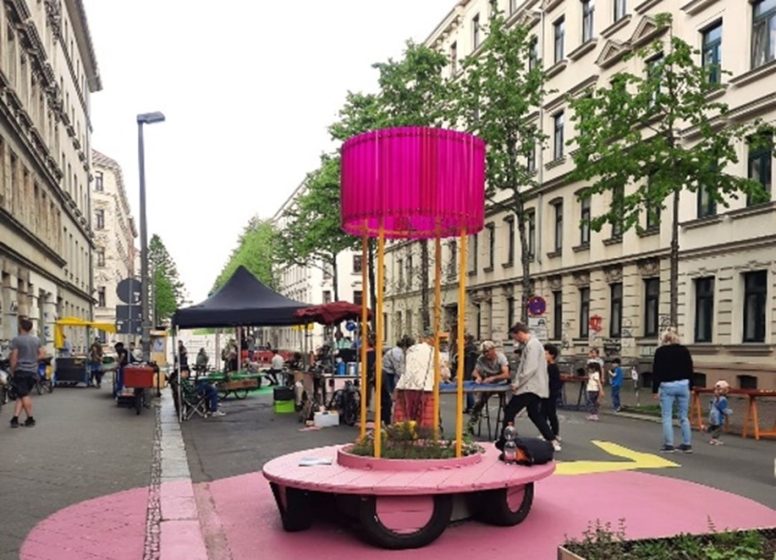
In our work, we encounter various issues stemming from the growing shift to the right in our society and the mounting scepticism towards science in the aftermath of the “authoritarian turn” observed worldwide. These developments are affecting opportunities for cooperation and discussion, and are jeopardising the trust-based collaboration that is essential for transdisciplinary research. Consequently, the foundations of our approach have been shaken, prompting us to consider how to respond to the new situation, how to continue working with practitioners, and how to ensure our research remains relevant and helpful.
We are finding it increasingly difficult to recruit sceptical actors and experts for interviews or workshops; part of the research field is ‘closing itself off to us’. Even with local practitioners, it is becoming more difficult to discuss topics that are currently politically and ideologically contentious, such as superblocks and other conflicts of urban land use, including brownfield sites, former rubbish dumps, and railway areas.
As researchers, we are no longer perceived as “neutral” and are increasingly losing our self-attributed role as “honest brokers”. Working at an environmental research centre funded by the government means I have a “pro-transformation mission” and a related position that makes me an “opponent” in the eyes of others, who therefore do not want to talk to me. This situation is not entirely new, but it has become much more acute in recent years.
At the same time, it is becoming increasingly challenging to develop ideas for civil society alongside our partners in the field. How can we continue to provide relevant support? What analyses and contributions do our partners in practice need to be able to argue in favour of transformation in polarised discussions? As we have seen in many projects, local initiatives such as superblocks or contested areas often become “arenas” in which general issues are negotiated. What kind of city do different groups of people want for the future? How do these ideas fit together? Who will benefit and who will suffer as a result of the transformation? Unfortunately, these discussions are not always objective, but increasingly turn into heated conflicts, with people resorting to social media, protests, and counter-protests, and even deadlock, where they no longer talk to each other. As issues become more complicated, it becomes more difficult to discuss them objectively and in a nuanced manner. Scientific arguments do not necessarily make discussions more objective. As a researcher, one increasingly encounters conceptual and methodological limitations.
We are currently facing many challenges and have many questions about ourselves, our role, and our self-image. We are also asking ourselves how we can be relevant and supportive in the new context, including in our cooperation with politics and practice. In eastern Germany, where Leipzig is located, we must also consider how to prepare for a time when right-wing parties such as Alternative for Germany (AfD) may come to power in our federal state of Saxony, as could happen in the next state elections in 2027. This is particularly pertinent when our partners increasingly come from the right wing of the political spectrum and when scepticism and hostility towards science find their way into the ministries. What will this mean for our environmental and transformation research? What will it mean for the many left-wing, migrant, and queer civil society partners we work with?
We must address these questions seriously, consider the options available to us, and make strategic decisions today. I don’t yet have answers to many of these questions. However, I see admitting this to ourselves and sharing it with the community as an important first step. We must realise that this is not just a temporary danger; we may have to prepare for a prolonged period during which our basic principles and fundamental beliefs in democratic, freedom-based urban transformation research will no longer have the support of the political and social majority. Recognising this, we should focus on the question of how we can reframe narratives about and experiences of urban transformation so that they present a desirable vision for the future, not only for those who are already benefiting from it today, but for the majority of the urban population. We must link the challenges of transformation to the pressing issues of everyday life, such as the availability and cost of housing, energy, and food prices, and the opportunities to lead a good life even under changed circumstances. This could restore confidence in shared goals and, more broadly, strengthen faith in democratic coexistence.

about the writer
Toni Luna
Toni Luna has taught geography at Universitat Pompeu Fabra (UPF) since 1996. He has served several positions at UPF: Academic Coordinator of Interantional Programs, HEad of the Humanities Department, Academic Coordinator of the Global Studies Degree, and Vicerector of International Relations. His recent projects engage with geohumanities, hydrosocial territoriality, and creative approaches to understanding landscapes and communities.
Toni Luna
We need to understand that this is a struggle about narratives. If science continues speaking only to itself while others actively shape public understanding, then science will not only be silenced. It will become irrelevant.
The rise of autocracy across the world is not only suffocating science but also disciplining scientists. Governments restrict academic freedom and control institutions, while scientific careers are increasingly reduced to writing proposals, chasing funding, and adapting to externally defined priorities. Science risks becoming less about discovery and more about survival within bureaucratic and political systems.
Autocratic leaders are effective because they offer simple explanations of a complex world. They tell clear stories and propose solutions that feel immediate and emotionally satisfying. Science, on the other hand, speaks in complexity, uncertainty, and nuance. This is necessary, but it is not always accessible. Too often, scientists communicate in technical language, through journals and conferences, speaking mainly to other scientists. From outside, this can appear distant, abstract, even arrogant. We insist on complexity, while others turn simplicity into a political tool.
At the same time, the scientific system itself is deeply shaped by metrics, rankings, journals, and funding structures. Academic careers depend on citation counts, impact factors, and publication outputs, often controlled by a small number of global publishing corporations. Knowledge produced with public funding often ends up locked behind paywalls or restricted to small academic communities, far from the society that paid for it.
Research agendas are also influenced by funding agencies and institutional priorities, many of them based in the Global North. This creates strong geographical imbalances in knowledge production. Not all regions have the same capacity to define research questions or circulate knowledge. Postcolonial relations are still present in academia: knowledge is often produced about certain territories, but not from them. Local perspectives are frequently marginalized. So when we talk about defending science, we should also ask: which science, and whose knowledge?
Meanwhile, we are living in an information environment transformed by digital platforms. Social media amplifies not only information, but also misinformation, half-truths, and manipulation. Algorithms reward outrage, simplification, and emotional content. In this context, scientific knowledge is not only competing with ignorance, but it is also competing with industrial-scale disinformation, often supported by powerful actors. And all this is happening within a broader geopolitical context that we cannot ignore.
Many conflicts today are presented as ideological or cultural. But if we look more carefully, most wars, past and present, are fundamentally about money and power, expressed through control over resources and sovereignty. They are about who controls territory, who extracts its wealth, and who benefits from it. Ideology, religion, and nationalism often serve as narratives to justify these conflicts, but they frequently act as cover for deeper material struggles over land, energy, water, and strategic dependencies, often for the advantage of a limited number of actors.
This is directly connected to sustainability. Climate change, ecological degradation, and resource scarcity are not only environmental issues, but they are also already shaping geopolitics, inequalities, and conflicts. Some regions suffer the strongest impacts, while others still dominate decision-making and knowledge production. In this context, scientists cannot simply retreat into academic publishing and assume that evidence will speak for itself. Evidence does not speak unless someone speaks for it.
Producing knowledge is no longer enough. We must learn to communicate it more clearly, more directly, and more publicly. This means going beyond journals and policy reports, engaging in classrooms, public debates, community spaces, and cultural contexts. Trust is built through presence and dialogue, not only through publications. We also need to communicate the urgency differently. Sustainability is too often framed as a problem for future generations. But its consequences are already here, affecting economies, security, and everyday life.
And finally, we need to understand that this is also a struggle about narratives. If science continues speaking only to itself while others actively shape public understanding, then science will not only be silenced. It will become irrelevant. And when science becomes irrelevant, decisions about resources, territory, sovereignty, and our shared future will no longer need evidence. They will be taken by those who already hold power and who have no interest in sharing it.

about the writer
Basil Bornemann
Basil Bornemann (PD Dr) is a senior researcher and lecturer at the Department of Social Sciences, University of Basel, and track coordinator of the international joint degree Bachelor in Sustainability (BASUS) at the University of Zurich. His research focuses on sustainability and democracy, the sustainable state, social-ecological transformations and conflicts (with emphasis on the food system), and the principles and practices of transformative sustainability research. He acts as co-president of the Swiss Academic Society of Ecology and Environmental Research (saguf) and co-speaker of the standing group Environmental Policy and Global Change of the German Political Science Association.
Basil Bornemann
The instinct to defend sustainability science against authoritarian attack is right but incomplete. Defense must go hand in hand with a transformation of science.
Defend and Transform: Sustainability Science Under Authoritarian Pressure
Assaults on science in democracies undergoing authoritarian backlash are real, and their consequences are severe. Sustainability science has come under particular pressure. Defunding research institutions, replacing scientists, and pulling out of international knowledge networks are not merely signs of resurgent fossilist interests; these attacks on science are part of a broader playbook for destabilizing liberal democracies. Committed to evidence, plurality, and public reasoning, science is targeted as a constitutive element of democratic culture. Undermining science and weakening democracy are, in this sense, the same project.
But this way of seeing, as straightforward as it is, tells only part of the story. It casts science purely as victim and democracy’s ‘innocent guardian,’ and in doing so forecloses a more uncomfortable question that science, an institution of self-reflection, should ask: what role has (sustainability) science itself played in creating the very conditions of authoritarian decline?This is not the place to recapitulate the rich literature on science’s negative impacts on democratic societies. I focus on three tendencies in sustainability science that, while far from universal, have been sufficiently dominant to carry real democratic consequences.
The first is technocratization. Sustainability science has repeatedly presented itself as the authoritative arbiter of what societies must do. Framings like ‘planetary boundaries are non-negotiable’ are not wrong as statements of biophysical fact, but they may cover up political implications. Whether, and how, societies choose to respond to ecological limits is a question saturated with values, trade-offs, and legitimate disagreement. When science forecloses that debate rather than opening and informing it, it depoliticizes precisely the spaces where democratic deliberation is most needed, and hands authoritarian actors a ready-made target: an expert class that tells “the people” what is right and what is wrong.
The second tendency is the neglect of inequality. Sustainability science organized itself primarily around ecological problems, treating the social largely as a condition for ecological dynamics rather than as a constitutive dimension of social-ecological problems in its own right. This created long-standing inattention to the deep inequalities that structure both environmental harm and the capacities to address it. Thereby, sustainability research reproduced existing power relations rather than challenging them – and came to be perceived, by those on the losing end, as a partner of incumbent elites rather than a resource for those most harmed by the crises it studies.
The third tendency is cultural estrangement. Just as markets, under neoliberalism, became detached from the social fabric that once gave them meaning and constraint, science has undergone its own disembedding: The metrics, rankings, and knowledge-economy logics that have remade universities in the neoliberal image, led to a growing divide between the cosmopolitan world of science, with its aesthetic of abstraction and numerical precision, and the experiential registers of culturally embedded lifeworlds. This is not simply a problem of communication; it is one of alienation, where science and the lifeworld fail to maintain meaningful relations of mutual recognition.
Taken together, these tendencies have — alongside many other forces — helped erode the democratic conditions on which science itself depends. Technocratic framings close down political debate and breed resentment toward expert authority. The neglect of inequality has estranged science from those whose lives sustainability crises most directly affect. Cultural disembedding has severed the bonds of recognition and trust without which knowledge cannot circulate as a democratic resource. To be clear: science did not cause the authoritarian turn. But it has co-produced some of the soil in which that turn has flourished.
What now, then? The instinct to defend sustainability science against authoritarian attack is right but incomplete. A science that seeks to repel external assault while leaving its own drifts unchanged will remain not only vulnerable to the next wave of attacks but also implicated in enabling them. Therefore, defense must go hand in hand with a transformation of science.
The good news is that considerable transformative resources already exist within sustainability science itself. Transdisciplinary research, participatory and community-based approaches, scholarship that centers justice and inequality, and epistemologies that take seriously non-scientific and Indigenous ways of knowing are increasingly growing and maturing strands of scientific practice. They represent science operating not as a lecturer but as a listener; not as an arbiter of what must be done, but as a partner in working out how. They also model a different relationship between knowledge and democratic life, one in which science earns its authority through meaningful engagement rather than asserting it through expertise alone. One task is to strengthen these strands and enable them to reshape the broader practice of sustainability science from within, thereby strengthening sustainability and democracy alike.

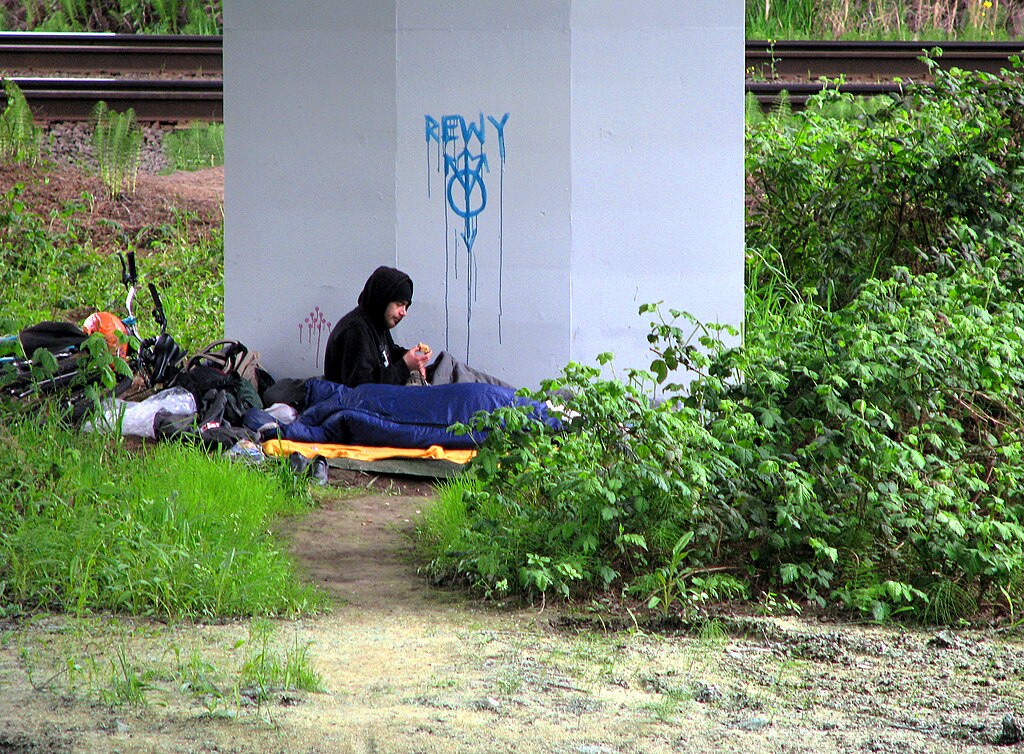
Leave a Reply